
This is the second in a series of four posts on the American Civil War. In this series, I describe the three combat arms used during the Civil War to accomplish military objectives (cavalry, infantry, and artillery). In the final post of the series, I’ll describe the role of the Civil War chaplain. In today’s post, I’ll examine the life of a Civil War infantryman. You can read the first post in the series on the Civil War cavalryman HERE.
With each post, I’ll also include the story of a Spaulding family member who served during the Civil War in each of these roles.
The Infantryman
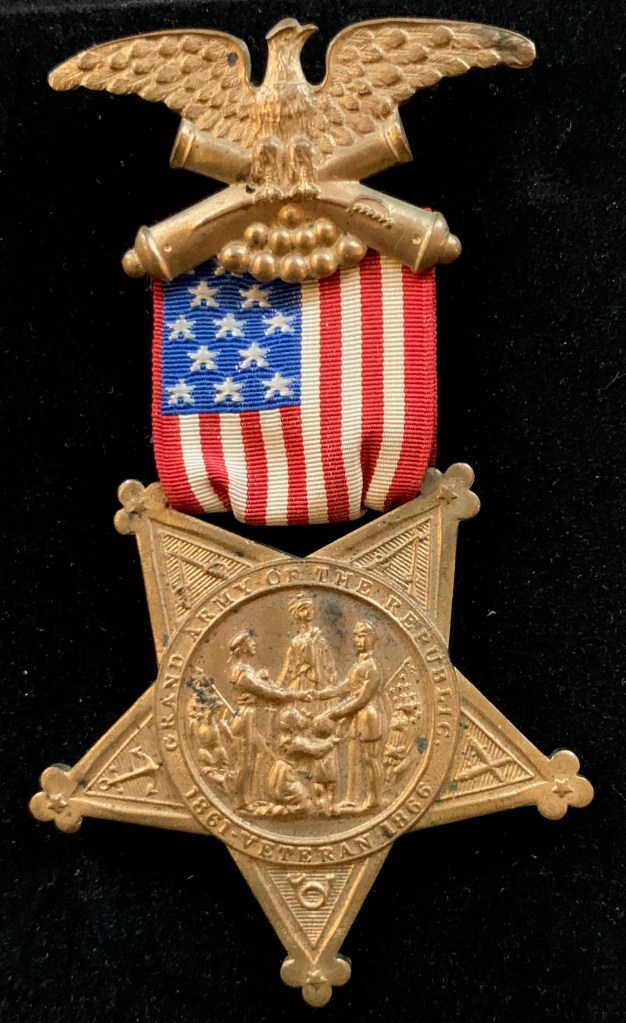
In early 1861, eleven southern states seceded from the United States to form the Confederate States of America (CSA). Tens of thousands of Southern men organized companies which formed into regiments and brigades. President Lincoln responded by issuing a call for 75,000 volunteers to put an end to the rebellion and restore the union. More than 1,700 state volunteer regiments were raised for the Union Army. Approximately 80% of these Union soldiers served as infantryman.1
The Civil War infantry regiment (commanded by a colonel) consisted of about 1,000 soldiers organized into ten companies of 100 men (each commanded by a captain). Regiments were designated by a number and the name of the state that raised them.1 For example, my 3rd great-uncle, Private Oscar Spaulding (his story below), served with Company A of the 2nd Massachusetts Infantry.
The standard weapon of the infantry soldier on both sides of the Civil War was the rifle musket, the most common being the Springfield Model 1861. The infantryman also carried a bayonet with a scabbard (sheath) to house it, a box of percussion caps, and a cartridge box to hold about 40 rounds of ammunition. Infantry Officers were armed with a revolver and a sword.1
Private Oscar Spaulding
Oscar Spaulding was the youngest child of my 3rd great-grandparents Addison and Nancy Spaulding.
On May 25, 1861, at age 18, Oscar answered President Lincoln’s call to service. He quit his job at the Lowell Textile Mill and joined the Union Army. Private Oscar Spaulding was assigned to Company A of the 2nd Massachusetts Infantry Volunteers. From May to July of 1861, the men of the 2nd Mass. trained as a unit. Then, on July 8, 1861, they boarded a train and headed south to get in the fight.
About a year later on August 9, 1861, Private Oscar Spaulding’s unit was involved in a horrific battle at Cedar Mountain, Virginia against Confederate General Stonewall Jackson’s men. This fateful day would forever change the Spaulding family.
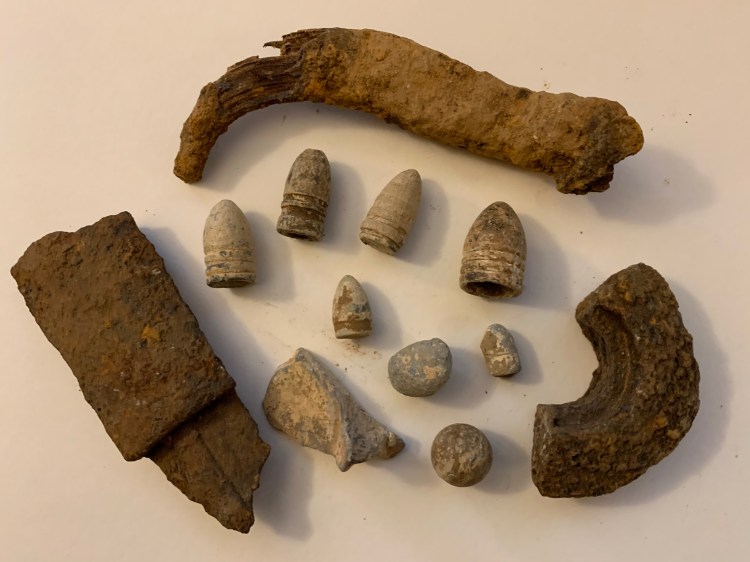
Private Oscar Spaulding was mortally wounded during that battle. He was struck twice in the right leg and once in the arm, breaking the bone. After the fight was over, Oscar was taken from the battlefield to the nearby field hospital. Once stabilized, Oscar was taken by horse-driven ambulance to the regimental hospital in Culpepper, Virginia and ultimately admitted to the Mansion House Hospital in Alexandria, Virginia, on August 14, 1862, where he continued the battle—now for his life.
Just three days after he arrived, Private Oscar Spaulding died from his wounds on August 17, 1862, just one day shy of his 20th birthday. Here’s a brief excerpt from a man of Oscar’s hometown who chronicled what he learned about the Battle of Cedar Mountain in a letter to the Lowell Daily Courier.
The enemies’ fire was terrible. The entire loss of the regiment was suffered in half an hour. I saw Oscar Spaulding on Saturday in the hospital at Alexandria. He had two bullets through one leg and an arm broken. He talked pleasantly and cheerfully; so much so that I thought there was no doubt of this recovery. Yet, he died on Monday.
Benjamin Dean (1862)
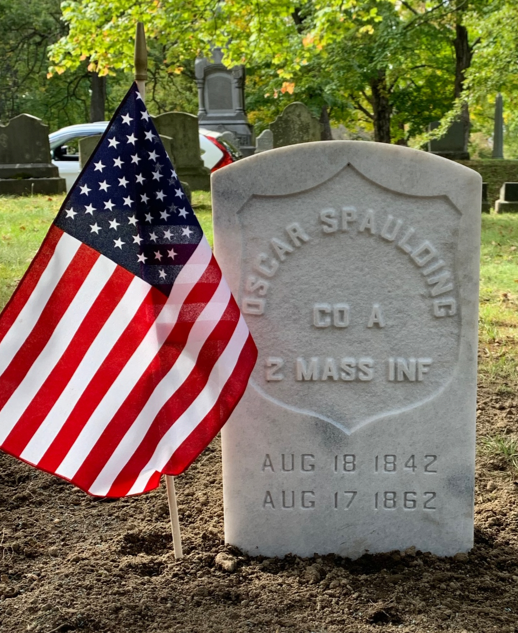
The Lowell Daily Courier reported Oscar’s death and burial in a series of newspaper articles. Here’s one of those articles from August 26, 1862.
The funeral of Oscar Spaulding, who died of wounds received in the Battle of Cedar Mountain, took place from the residence of his father in Centralville, this forenoon, and was attended by Mayor Hosford and a committee of the City Council. There was a large attendance, and a long procession followed the remains to the grave. Rev. J.J. Twiss conducted the services. The hearse was draped with the American flag. The remains were interred in the Lowell Cemetery.
Lowell Daily Courier (1862)
Memorial Day
In May 2021, I visited the site of the Battle of Cedar Mountain just south of Culpeper, Virginia. It was a cool, crisp spring day with bright and brilliant blue skies. The tall grass on the battlefield fluttered back and forth in the gentle breeze. It was a quiet and peaceful day, as there were no other visitors at the site. I sat on the ground overlooking the battlefield attempting to grasp what it must have been like for my 3rd great-uncle Private Oscar Spaulding that day. I thought about his remarkable courage in the midst of arduous combat. I tried to imagine the excruciating pain he endured when he was wounded three times. It was difficult to image the devastation of battle in now such a tranquil place.
I wish we didn’t have to have Memorial Day, but I’m thankful that we do. I will never forget the heroic sacrifice of my 3rd great-uncle Oscar!
August 17, 1862, proved to be a day of utmost sorrow and yet utmost joy for the Spaulding family. Why? Because on that day Addison and Nancy Spaulding (my 3rd great-grandparents) grieved the loss of their youngest son, Oscar, to the Civil War. And on that very same fateful day, they rejoiced in the birth of their first grandchild, Arthur Addison Spaulding (my great-grandfather).
The Bible speaks to times we experience both joy and sorrow, laughing and weeping, and mourning and dancing in Ecclesiastes chapter 3. August 17, 1862 was that day for my 3rd great-grandparents.
Fortitude
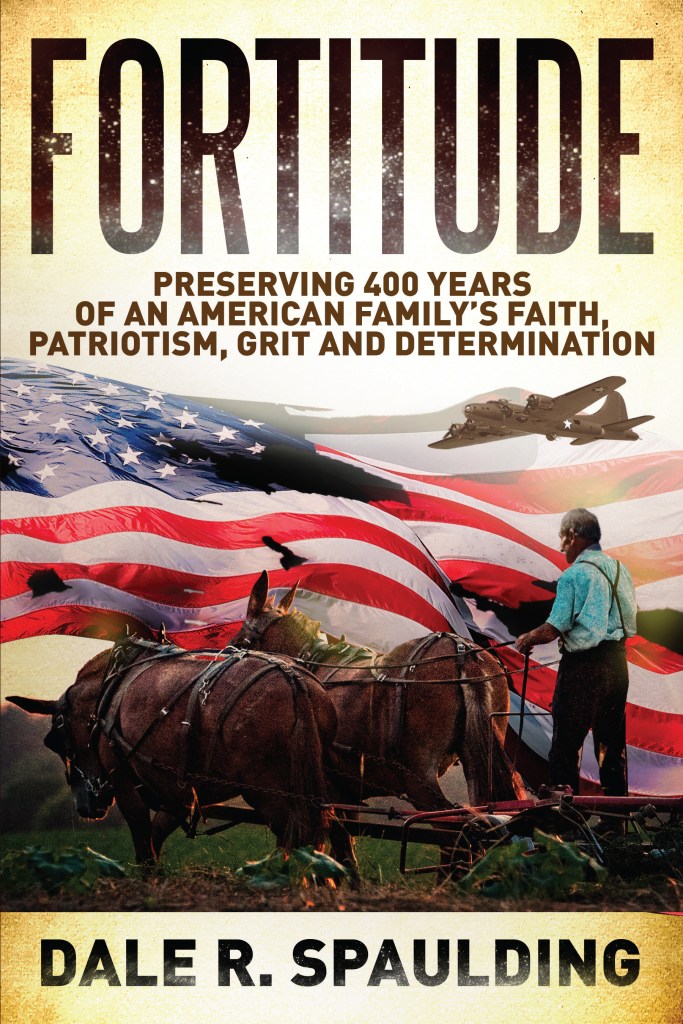
It’s stories like that of Private Oscar Spaulding that inspired me to name my book Fortitude. A person of fortitude has the strength of mind to enable them to face into danger or adversity with courage. Fortitude is the story of young men like Private Oscar Spaulding of Lowell, Massachusetts.
If you’d like to read more of the compelling story of Oscar and other patriots like him that have been part of the fabric of America since its inception, please check out my book Fortitude: Preserving 400 Years of an American Family’s Faith, Patriotism, Grit and Determination HERE.
NOTES
- Wikipedia. Infantry in the American Civil War. Accessed from https://en.wikipedia.org/wiki/Infantry_in_the_American_Civil_War on June 30, 2023.
- Featured Image: garry-t-cMabRa25yZI-unsplash.jpg by Garry T. Accessed from https://unsplash.com/photos/cMabRa25yZI on July 4, 2023.
Discover more from Fortitude
Subscribe to get the latest posts sent to your email.
 Fortitude
2 thoughts on “A Civil War Infantryman’s Story”