
In today’s challenging world, you’ve likely come in close contact with someone who is poor. Someone who is homeless and living on the street. Someone down on their luck who lost a job and has no savings to fall back on. Perhaps poverty is even hitting close to home with a family member of yours.
Poverty is prevalent in American’s cities but it’s also widespread in rural areas as well. Although widely inadequate, the United States provides a government safety net for the poor through social welfare programs. There are countless opinions (both positive and negative) on the effectiveness of these programs.
Have your ever wondered how the poor were taken care of in the United States prior to the enactment of government social welfare programs? In today’s post, I’ll examine how the poor were provided for prior to 1935 when the Social Security Bill was signed into law by President Franklin D. Roosevelt.1
British Beginnings
Formally caring for the poor in western civilization first took place with local British church parishes. Later, the responsible was set within the community itself. The Overseer of the Poor was a local official who administered poor relief in terms of money, food, and clothing. In 1597, this position was signed into law in England through the Act for the Relief of the Poor. This act served as the first legislation to provide assistance for the poor and formed the basis for the care of the needy in England for the next two centuries.2
Overseers of the poor were often reluctant appointees who were unpaid. England’s law required two overseers of the poor that were elected annually. Overseers were generally selected from lay church leaders or landowners. Duties of the Overseer of the Poor included estimating the poor relief budget, setting/collecting the Poor Rate (a property tax used to provide poor relief), distributing poor relief, and supervising the poorhouse (a local facility to support and provide housing for the needy).
Colonial Continuance
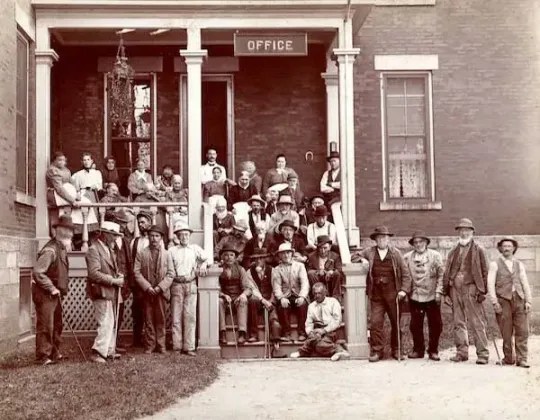
Colonial America derived many of its laws from Great Britain. One of which was how to provide for the poor. During the early days of the British colonies, the poor were supported by fellow community members. As colonial towns were established, overseers were selected to administer support for the poor funded through the poor tax. Housing arrangements called the almshouse, poorhouse, workhouse, and the poor farm sprung up across New England in the 18th century.3
As the population in colonial America increased, so did the number of impoverished citizens. After the American Revolution, newly formed states responded to the growing challenge of the poor by drafting legislation to address the needy. In 1797, Vermont enacted a law requiring every town to support and maintain their own poor. And to appoint overseers to support and maintain the poor, sick, and other inhabitants within their town not able to support themselves. In the local poorhouse, residents were expected to help with their support through work assignments. Poorhouses across New England also housed mentally and physically handicapped citizens whose relatives could not manage their care at home.4
Orders and regulations to govern New England poorhouses were documented in local bylaws. For example, Article I of the Westford, Massachusetts workhouse states:
“The overseers of the poor shall have the inspection and government of the workhouse, with full power to appoint a master and needful assistants; the said master to be a man of temperance, providence, and good moral character.”5
Article IV of the Westford Workhouse Bylaws describes the meals provided to the residents.
“For breakfast and supper hasty pudding and milk or molasses, bread and milk, or milk porridge, except on Sunday, when minced meat and bread and bohea tea may be served; and for dinner on each day of the week as follows, to wit:
- Sunday: Baked meat and beans and Indian pudding
- Monday: Salt fish and potatoes
- Tuesday: Boiled salt meat and vegetables
- Wednesday: Roasted or baked meat and vegetables
- Thursday: Soup
- Friday: Stewed beans or peas
- Saturday: Boiled salt meat and vegetables
And sufficient quantity of bread, beer or water at all meals.”5
Ben Franklin’s Thoughts
Benjamin Franklin was a charitable person; however, he wasn’t shy in voicing his differences on the methods (and results) used to address the issue of the poor. Here are Franklin’s thoughts from 1766:6
I am for doing good to the poor, but I differ in opinion of the means. I think the best way of doing good to the poor, is not making them easy in poverty, but leading or driving them out of it.
Benjamin Franklin (1766)
On the contrary, I affirm that there is no country in the world in which the poor are more idle, dissolute, drunken, and insolent. The day you passed that act, you took away from before their eyes the greatest of all inducements to industry, frugality, and sobriety, by giving them a dependence on somewhat else than a careful accumulation during youth and health, for support in age or sickness. In short, you offered a premium for the encouragement of idleness, and you should not now wonder that it has had its effect in the increase of poverty.
Benjamin Franklin (1766)
Family Connections
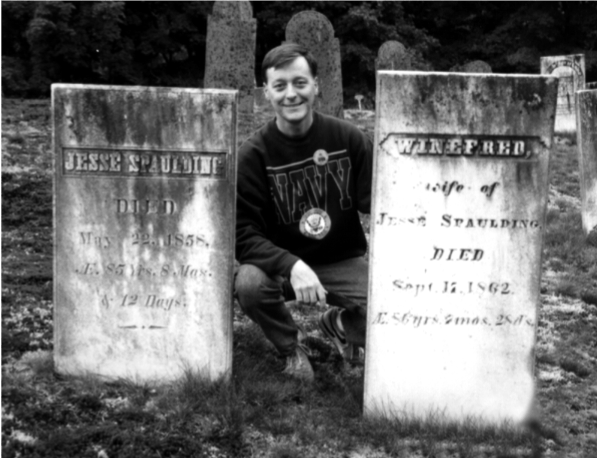
My 4th great-grandfather, Jesse Spaulding, was born September 20, 1772, just four years before the signing of The Declaration of Independence. Jesse’s father, Captain Benjamin Spaulding (my 5th great-grandfather), served during the American Revolution in the New Hampshire Militia.
Jesse married Winifred Swift, daughter of James and Winifred (Davis) Swift of Boston, on May 20, 1798. John Adams was the second president of the United States at that time. Jesse and Winifred settled on land bordering the Twenty-Mile Stream below the Gilchrist School in Cavendish, Vermont. Jesse and Winifred, like many others in the region, were farmers.
Like many Spauldings before them, Jesse and Winifred had a large family of ten children born between 1799 and 1820. Yes, that’s 10 children in 21 years!
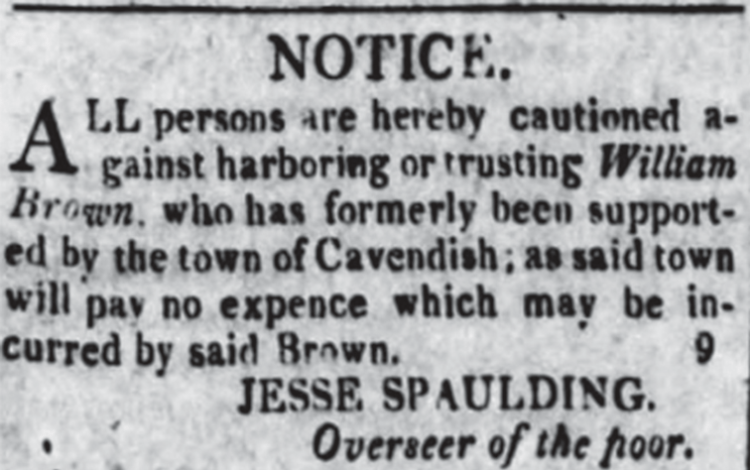
In addition to farming, Jesse helped enact Vermont’s legislation to provide for the needy by serving as Overseer of the Poor in the town of Cavendish in the early 1800s. It appears there was a system of accountability in place during that time as evidenced by the NOTICE regarding William Brown posted by Jesse Spaulding in the Vermont Republican newspaper on September 13, 1819.
During the 1800s, there were members of the Spaulding family that fell on hard times in New England requiring the services of the poorhouse. A record from March 10, 1827 shows that Ephraim Spaulding and his wife Hannah were residents at the poor farm in Westford, Massachusetts. In 1824, the town of Westford purchased John Read’s farm (170 acres) for $2500 to serve as a poor farm.5 Ephraim Spaulding died at the Westford poor farm on January 5, 1831 at age 64. His wife Hannah also died at the poor farm the following year on June 27, 1832.
Biblical Worldview
Unfortunately, the the poor will always be with us – a sad, but undeniable, truth. For centuries, politicians have made promises to curtail poverty, but the issue still remains. The fallen world we live in simply cannot escape poverty. Government social welfare systems provide some relief, however, those with the financial means should be generous with what they’ve been blessed with to help the poor.
God clearly has a special place in his heart for the poor. His words about the poor are dispersed throughout the pages of the Bible. Let these scripture verses encourage and challenge us to give to those in need.
For there will never cease to be poor people in the land; that is why I am commanding you, ‘Open your hand willingly to your poor and needy brother in your land.’
Deuteronomy 15:11 (CSB)
Speak up for those who cannot speak for themselves, for the rights of all who are destitute. Speak up and judge fairly; defend the rights of the poor and needy.
Proverbs 31:8-9 (NIV)
Silver Medal Award

If you enjoy U.S. History and stories of how ordinary, faithful, hardworking, and patriotic people like Jesse Spaulding intersected those moments in history, you may want to check out my book: Fortitude: Preserving 400 Years of an American Family’s Faith Patriotism, Grit, and Determination. Click HERE for information.
My book was recently awarded the 2023 Readers Favorite Silver Medal for Non-Fiction: Genealogy. Learn more about the award HERE.
REQUEST: If you enjoyed reading this post, please click the LIKE button below and leave a comment. I look forward to hearing from you. THANKS!
NOTES
- Social Security Administration. Social Security History: Fifty Years Ago. Accessed from https://www.ssa.gov/history/50ed.html on October 3, 2023.
- Wikipedia. Act for the Relief of the Poor 1597. Accessed from https://en.m.wikipedia.org/wiki/Act_for_the_Relief_of_the_Poor_1597 on October 3, 2023.
- New England Historical Society. A Poorhouse in Each New England State. Accessed from https://newenglandhistoricalsociety.com/poorhouse-each-new-england-state/ on October 5, 2023.
- Hoffbeck, Steven R. “Remember the Poor” (Galatians 2:10): Poor Farms in Vermont. Vermont History: The Proceedings of the Vermont Historical Society, Fall 1989, Vol. 57, No. 4, pp. 226-227.
- Westford Town Farm. Accessed from https://www.westfordma.gov/DocumentCenter/View/12653/Town-Farm-History—Narrative on October 7, 2023.
- Charles, Joshua. Ben Franklin on the Welfare State. Accessed from https://www.joshuatcharles.com/blog/2018/12/10/ben-franklin-on-the-welfare-state#_ftn3 on October 6, 2023.
- Featured Image: Town Farm, Nashua, N.H. 1893. Photograph by C. E. Powers. Accessed from https://www.westfordma.gov/DocumentCenter/View/12653/Town-Farm-History—Narrative on October 20, 2023.
- Image: New York Poorhouse. 1900. Cruel Charity and the American Poor Farms. Orange Bean, February 9, 2021. Accessed from https://orangebeanindiana.com/2021/02/09/cruel-charity-and-the-american-poor-farms/ on December 6, 2023.
Discover more from Fortitude
Subscribe to get the latest posts sent to your email.
 Fortitude
Thanks for the article, Dale. Gold as usual.
LikeLiked by 1 person