
This month’s Fortitude post is all about ancestral mathematics. Now you’re excited, aren’t you? Let’s take a look backward and forward in time at the sheer volume of our ancestors and descendants in terms of exponential growth.
Exponential growth is a mathematical process that increases quantity over time – but at an ever-increasing rate. Exponential growth occurs when the rate of change (the derivative) of a number, with respect to time, is proportional to the number itself. For the visual learner, the graph of an exponential function is nonlinear – it’s shaped like a curve sloping more and more upward over time.
Ok, enough on exponential functions – let’s get to the point.
Once you start on the genealogy journey, you are never really “done”. You may get to a position where no other records exist to trace you ancestors further back, but your linage is not complete, as that work in itself would be astronomical. Here’s the case mathematically.
Looking Backward
Our ancestral past is a binary tree that increases exponentially over time. Each of us have two parents, four grandparents, eight great-grandparents, etc. And this math continues exponentially with each generation looking backward in time. For example, looking back four generations, we have 16 second great-grandparents (2x2x2x2) or 2 raised to the power of 4 (2^4). The table below shows the number of direct ancestors we have going back 12 generations.
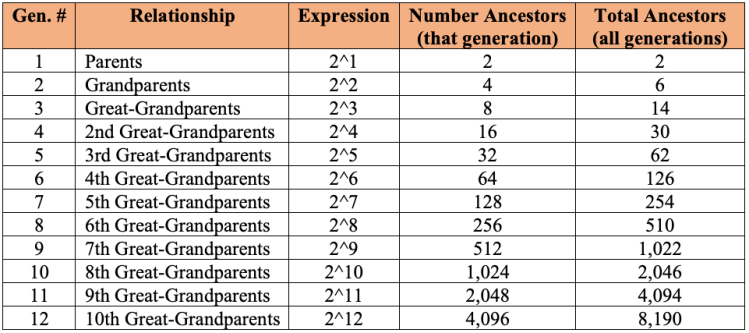
It took many years to research and identify the names of my 14 total ancestors going back just three generations. Now make the leap to the 4th, 5th, 6th, or even 10th generation (2,046 total ancestors) and see how the exponential multiplication of genealogical research becomes overwhelming, if not impossible. This is why I say that the work is never “done”. That is unless you’ve identified all 4,096 of your 10th great-grandparents!
Pedigree Collapse

If we continue backward in time, the number of direct ancestors we have at the 20th, 30th or 50th generations becomes astronomical as exponential multiplication drives those numbers through the roof. At some point those numbers become impossible due to a phenomena called “Pedigree Collapse”.
American genealogist, Robert C. Gunderson (1931-2003), supervisor of the Royalty Identification Unit of the Genealogical Society of Utah, first introduced the term, “Pedigree Collapse”.1
So, why do I say the numbers become “impossible” due to Pedigree Collapse?
Let’s say we have a new generation on average every 30 years. With that in mind, our 28th great-grandparents (30 generations back) would have lived 900 years ago during the Middle Ages around 1200 AD. Our number of ancestors at 30 generations back would be 1,073,741,824 (2^30). This number becomes impossible because according to the Population Reference Bureau, the world’s population in 1200 AD was only 450,000,000.2
According to the International Society of Genetic Genealogy, “pedigree collapse describes how reproduction between two individuals who knowingly or unknowingly share an ancestor causes the family tree of their offspring to be smaller than it would otherwise be”.1 So instead of having over one billion unique ancestors going back 30 generations, we have positions in our family tree occupied by a single person. As this phenomena occurs over the ages, the pure exponential multiplication rule no longer applies.
Looking Forward
Do you ever think about your future descendants? Sure, it’s easy to think about your children, grandchildren, or even great-grandchildren. But what about your descendants hundreds of years from now? Just how many descendants will you have then? The same exponential multiplication that applied to looking backward applies to looking forward.
Abraham from the Old Testament in the Bible must have pondered this same question when an angel of the Lord came to him and said:
“I will surely bless you and make your descendants as numerous as the stars in the sky and as the sand on the seashore.” Genesis 22:17
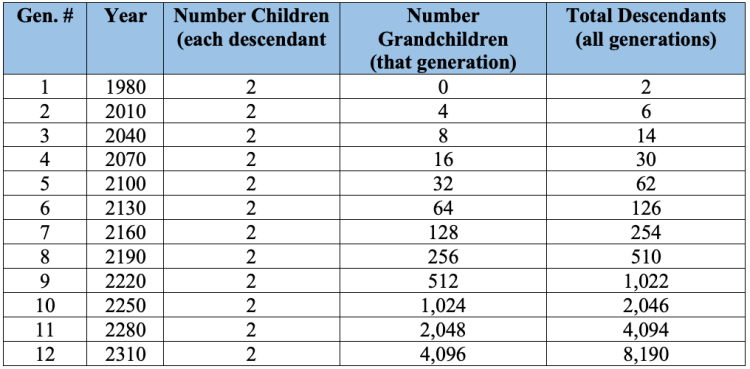
Let’s create a table looking forward similar to our looking backward table above. And, let’s again assume a new generation occurs on average every 30 years. I had my two sons in the 1980s, so I’ll begin the table there.
According to Statista, the average number of children per family in the United States in 2023 was 1.94.3 So in the table below, we’ll keep the math simple by assuming future families will have two children.
Leaving Digital Breadcrumbs

As I consider the data in the table above, I think about the generations that will follow me – my direct descendants. I wonder if my 9th great-grandfather, Edward Spalding, who lived in the 1600s, ever thought one of his descendants (me) would be learning all they can about his life 400 years after he was gone.
My conclusion – leave digital breadcrumbs! Leave a trail for future family historians to follow in order to discover your story 400 years from now. Here are some ideas for your digital breadcrumbs:
- Photo Book: Capture the “keeper” pictures in those old photo albums and create a digital photo book with names, dates, and captions.
- Memoirs: Document those significant events in your life through a series of written memoirs.
- Autobiography: Capture your entire life story via an autobiography.
- Blog: Start a blog by writing on topics of interest. Once you commit to blogging, be consistent (ex. post monthly). You can covert years of blog posts into a book via apps like Pixxibook.
- Book: Preserve your life story and the stories of your ancestors passed down to you via a family history narrative. I cover the steps for how to create your family history narrative (and get it published) HERE.
Final Thoughts
Exponential multiplication gives us a better understanding of genealogy both looking back in time and forward into the future. Seeing the scale of these numbers gives us pause to consider our own lives along with the thousands of ancestors that came before us and the thousands of descendants that will follow us.
Start developing your plan to leave digital breadcrumbs for future family historians to follow. What seems like everyday, normal (even boring) life events for you today will be fascinating for a descendant of yours to read about 200 years from now!
Like/Comment
If you’re currently researching your family’s history or have an interest to do so, click the LIKE button below and leave a COMMENT with your thoughts on the Exponential Multiplication in Geneology.
NOTES
- International Society of Genetic Genealogy. 2024. Pedigree Collapse. Accessed from https://isogg.org/wiki/Pedigree_collapse on May 16, 2024.
- Population Reference Bureau. 2022. How Many People Have Ever Lived on Earth? Accessed from https://www.prb.org/articles/how-many-people-have-ever-lived-on-earth/ on May 16, 2024.
- Statista. 2023. U.S. Average Number of own Children Per Family with own Children (1960-2023). Accessed from https://www.statista.com/statistics/718084/average-number-of-own-children-per-family/ on May 22, 2024.
- Featured Image: Moreu, E. 2021. Numbers Arranged in Rows. Accessed from https://unsplash.com/photos/a-large-number-of-numbers-are-arranged-in-rows-IJUI81_0Wc4 on May 26, 2024. Free to use under the Unsplash License.
- Ossayli, A. 2017. Analog Alarm Clocks. Accessed from https://unsplash.com/photos/photo-of-analog-alarm-clock-lot-laJW5pp-6Yw on May 26, 2024. Free to use under the Unsplash License.
- Dooley, I. 2017. Cup of Coffee near MacBook Pro. Accessed from https://unsplash.com/photos/cup-of-coffee-near-macbook-pro-DJ7bWa-Gwks on May 26, 2024. Free to use under the Unsplash License
Discover more from Fortitude
Subscribe to get the latest posts sent to your email.
 Fortitude