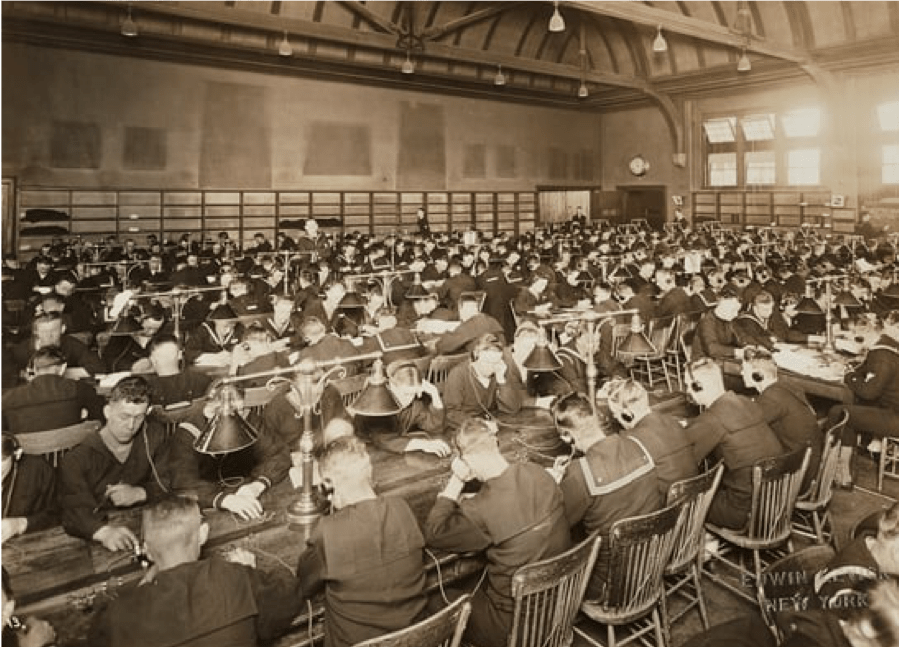
When I examine Harvard University through political lens today, I don’t perceive an ardent support of the United States military. Writing for History News Network, Richard F. Miller discusses reasons why in his article titled, Why Don’t Harvard Graduates Join the Military Anymore.1
This, however, wasn’t always the case at Harvard. During World War I, Harvard University played a vital role in the early days of Naval communications providing facilities to train U.S. Navy radio operators and technicians. In this month’s Fortitude post, I discuss the history of the Harvard Radio School and tell the story of my great-uncle who underwent training there during World War I.
Early Naval Radio History
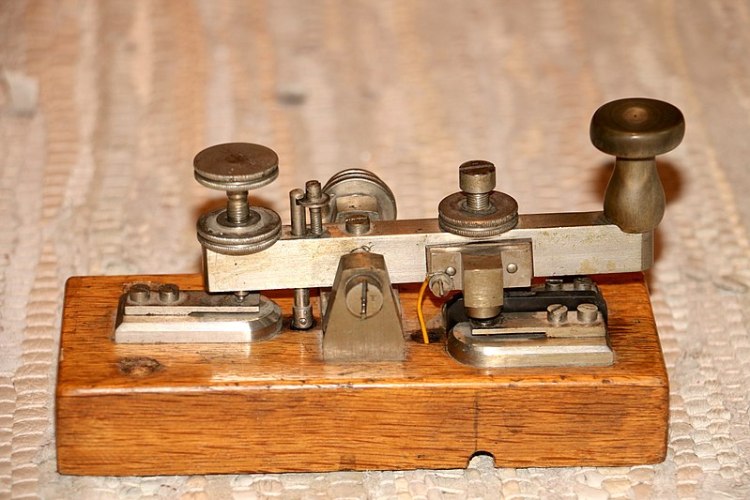
In 1899, the U.S. Navy began to evaluate the potential mission benefits of transmitting signals via electrical waves using technology developed by Italian physicist Guglielmo Marconi. Navy radio-wave systems leveraged Morse code, developed by Samuel Morse, to communicate, as technology to transmit voice electronically had not yet been developed.
Over the next two years, early radiotelegraphy systems were tested at the Naval Torpedo Station in Newport, Rhode Island, and aboard three ships. By 1904, radio systems were in operation at 18 U.S. Navy shore stations and aboard 24 ships.2
Harvard Radio School
On June 28, 1914, the assassination of Austrian Archduke Ferdinand set off a chain of events that led to the start of World War I.
The U.S. Navy soon realized that the Radio School at the Navy Yard in Brooklyn, New York couldn’t deliver the throughput of radio operators and technicians required to meet wartime operational demands. So the Navy began its search for a larger facility.3
Enter Harvard University.
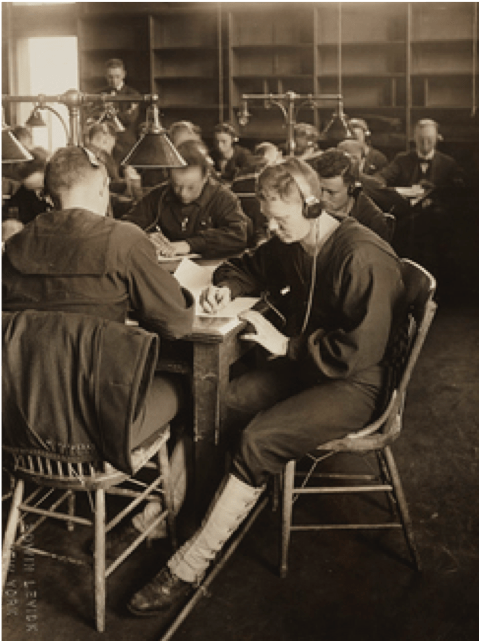
In April 1917, Harvard University’s Cruft Laboratory formed the first class of radio operators for the Naval Reserve Force. By July 1917, 830 sailors were enrolled in the Naval Radio School which consisted of 16 weeks of instruction. After successful completion of their Morse code and radio equipment training, the men were transferred directly to the fleet.
The Naval Radio School at Harvard trained nine of ten Morse code radio operators serving in World War I. By late 1918, the school graduated 165 men per week. As the Armistice was signed, signifying the end of World War I, the Naval Radio School at Harvard had nearly 3,500 men under instruction.3
The year following the end of World War I, the U.S. Navy transmitted radio voice communications (air to ground) for the first time. In 1929, the Navy transmitted its first voice communications between an aircraft and partially submerged submarine.4
The Spaulding Connection
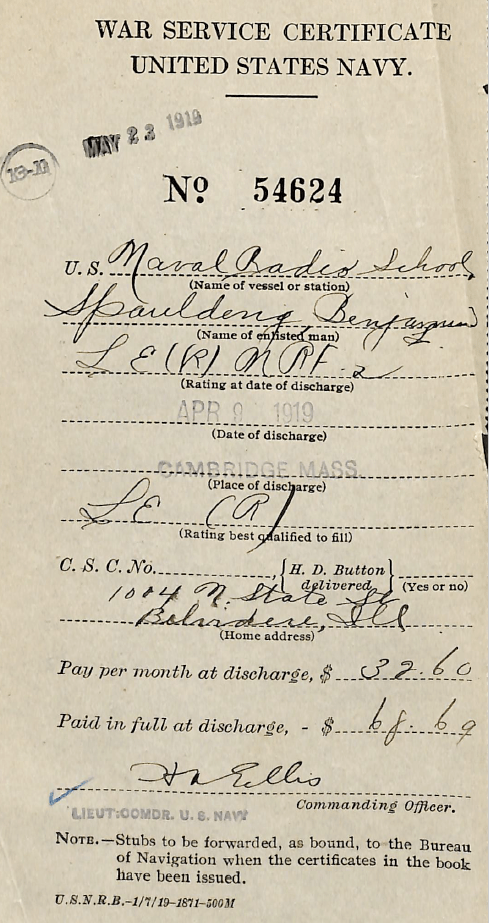
Born in 1895, Apprentice Seaman Benjamin L. Spaulding (my great-uncle), joined the Naval Reserve Force (NRF) on May 17, 1918 during World War I. Following Boot Camp at Naval Station Great Lakes, Illinois, he was trained at the Naval Radio School at Harvard University. Upon graduation, he was assigned the Navy rating of Landsman for Electrician (Radio), abbreviated as LE(R).
Apprentice Seaman Benjamin Spaulding was then transferred to the Ninth Naval District as a Naval Wireless Operator (Radioman) based out of Great Lakes, Illinois. Benjamin was discharged from the Naval Reserve Force on June 12, 1922, but he reenlisted three years later on January 26, 1925.
During his time in the Naval Reserve Force, now Seaman Second Class Benjamin Spaulding served aboard the USS Coghlan (DD-326) during his summer active-duty time in August 1926. After his promotion to Seaman First Class on July 1, 1926, Benjamin served aboard the USS Flusser (DD-289).
In 1930, Benjamin’s rating was changed from radioman to storekeeper. He served his final sea duty with the Naval Reserve Force onboard the USS Wilmette (Gunboat) in July and August 1931 as a Storekeeper Third Class (SK3). SK3 Benjamin Lombard Spaulding was honorably discharged from the NRF at the Ninth Naval District, Great Lakes, Illinois on January 25, 1933 after 12 years of service.
Personal Reflections

My great-uncle, Benjamin Spaulding, died on June 19, 1976. One year prior to his death, I followed in his footsteps and enlisted in the U.S. Navy in July 1975. Benjamin L. Spaulding is buried in Plot 11, 266 of the Fort Smith National Cemetery in Fort Smith, Arkansas.
Advancements in radio technology were rapid in the twentieth century. While serving in the Naval Reserve Force, my great-uncle Benjamin used Morse code messages transmitted by radio waves to communicate during World War I. In my early naval career as an Electronics Technician, I was trained on the maintenance and repair of communications equipment used by Navy radioman. Later in my career, as a shipboard Operations Department Head, I was overall responsible for the communications systems aboard my ship.
Unfortunately, I never met my great-uncle Benjamin Spaulding. I would have loved talking to him about his days at Harvard Radio School. It would have been fascinating to discuss changes in radio communications between his World War I Morse code days and my time at sea in the 1970s, 1980s, and 1990s using UHF, VHF, and Satellite communications.
NOTES
- Miller, R. 2024. Why Don’t Harvard Graduates Join the Military Anymore. History News Network. Accessed from https://www.historynewsnetwork.org/article/why-dont-harvard-graduates-join-the-military-anymo on June 1, 2024.
- Bullard, W. United States Radio Service. United States Naval Institute Proceedings. Vol. 40, No. 150. March-April 1914, p. 431.
- Gates, A. The U.S. Naval Radio School. The Recruit: A Pictorial Naval Magazine. Vol. V, No. 7, July 1919, pp. 15-17.
- Office of the Chief of Naval Operations. 1963. U.S. Naval Communications Chronological History, p. 10. Accessed from https://www.navy-radio.com/manuals/NAVCOMM-history-1963.pdf on June 10, 2024.
- Featured Image: U.S. National Archives. 1918. Harvard Radio School Class. Accessed from https://picryl.com/media/colleges-and-universities-harvard-university-us-naval-radio-school-harvard-f425db on June 15, 2024.
- Hp.Baumeler. 2017. Morse Key (from 1900). Accessed from https://commons.wikimedia.org/wiki/File:Morsetaste.jpg on June 15, 2014. Licensed under the Creative Commons Attribution-Share Alike 4.0 International license.
- U.S. National Archives. 1918. Radio Room at Harvard Radio School Class. Accessed from https://nara.getarchive.net/media/colleges-and-universities-harvard-university-us-naval-radio-school-harvard-b02610 on June 16, 2024.
Discover more from Fortitude
Subscribe to get the latest posts sent to your email.
 Fortitude

Good article Dale My dad many times said with more than a little tongue in cheek, that he went to Notre Dame. It was, I believe, a 3 or 6 month office training course after he had graduated from the University of Toledo in 1942. We need to get together before the holidays! David
LikeLiked by 1 person