
I’d like to introduce to you Florence Wilhelmina Momberger (1896-1991), my great-aunt. Florence was a World War I Navy veteran, a deputy sheriff, and a leader in the community of veterans. Here’s the remarkable story of this one tough lady.
Florence was born on May 10, 1896 in Hamburg, New York just south of Buffalo in a family of six children (three boys and three girls).
In 1914, when Florence was eighteen, World War I began following the assassination of Austrian Archduke Francis Ferdinand.1 United States involvement in World War I began three years later in 1917 when the U.S. Senate voted to declare war on Germany and German ally Austria-Hungary.2
World War I was a unique period in American history, as women had not previously been recruited for military service. Clerical and administrative demands were on the rise to support increased force requirements of the U.S. Navy to aid the war efforts. The U.S. Naval Reserve Act of 1916 was enacted to enlist qualified “persons” for service. Then Secretary of the Navy, Josephus Daniels, asked if there was any law that indicated a Yeoman must be a man? The answer was no and thus the Navy began recruiting women for the Naval Reserve force in 1917.3
The Veteran

A year later on September 18, 1918, my great-aunt Florence enlisted in the U.S. Navy. She was twenty-two. Florence’s older brother, Edwin W. Momberger (my great-uncle) previously answered the call the duty and joined the U.S. Army. At the time, Florence said, “My brother is fighting in the trenches in France, and I felt this was one way I could serve too.” While Florence’s father George (my great-grandfather) didn’t approve of her enlistment, he didn’t try to stop her.4
One of my most treasured family history photos is of siblings Florence and Edwin Momberger in their uniforms during World War I.
Florence Momberger’s naval enlisted rating was Yeoman (F). The “F” meaning female, a designation used by the U.S. Navy during World War I to distinguish the women from the men.3 She served at the Naval Ordnance Command in Washington D.C., releasing her male counterparts for duty aboard ships. She also served aboard a tugboat at the Navy Yard in Washington. YN2 (F) Florence Momberger remained on active duty until June 18, 1919 – she then went on to serve in the U.S. Naval Reserves until 1922.
Following her service in World War I, Florence joined the American Legion. Just prior to her discharge, a group of twenty women from the U.S. Naval Reserve Force petitioned for a charter to organize an American Legion Post. The petition was granted and Betsy Ross Post No. 1 was formed on May 22, 1919, composed entirely of Yeoman (F) of the U.S. Navy. Betsy Ross Post No. 1 was the first women’s American Legion Post and just the second post organized by the American Legion – the first being George Washington Post No. 1.5
In October 1919, Florence and her fellow veterans of Betsy Ross Post No. 1 voted to change their post’s name to USS Jacob Jones Post No. 2 in honor of the only U.S. Navy destroyer torpedoed and sunk by a German submarine in World War I. Over the next few years, the membership of Jacob Jones Post No. 2, comprised entirely of Yeoman (F) women, grew to over 1,200.6
The Deputy Sheriff
Florence eventually returned to her hometown in Hamburg, New York. She was an ambitious woman who found office work dull, and she was ready for her next big challenge following the war. She applied for a deputy sheriff’s position in Erie County, New York that was being offered to veterans and was accepted! She became the first woman in the history of Erie County to hold such office and one of the first female deputy sheriffs in the country.7
I wonder what my great-aunt Florence thought about the title of the 1922 Erie County press release announcing her hiring as a deputy sheriff. It read: “Who would resist arrest by this pretty girl deputy sheriff?”8 I can just see her shaking her head thinking, “we can do better than that”.
Deputy Sheriff Florence Momberger transported women inmates to the Sing-Sing maximum security prison in Ossining, New York. She would then catch a few hours’ sleep in an empty prison cell before making the 350 mile trip back to Erie County.4
With this deputy sheriff “first”, Florence Momberger became quite the celebrity, gaining notoriety in newspapers across the country and, at times, being treated like a dignitary. She was once invited to attend a 1923 baseball World Series game featuring the Yankees and the Giants in New York City – all expenses paid! At that game, Florence had the opportunity of a lifetime to meet the legendary Babe Ruth. Following that encounter, Florence proclaimed, “I wasn’t too impressed. I thought he was too fat to play baseball.”9
The American Legion Commander
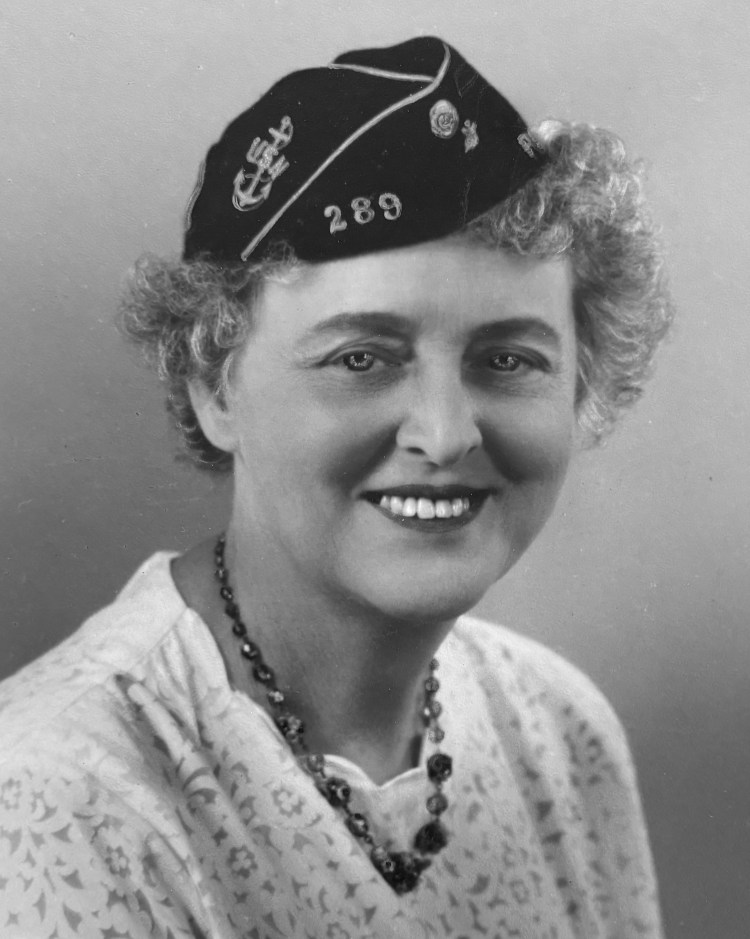
Later in life, Florence, and her husband Cornelius, moved to Port Orange, Florida. She continued to be active in the American Legion serving as Commander of Daytona Beach Post No. 289. She then served as District Commander of the American Legion, Department of Florida, 5th District.10 In 1989, my great-aunt Florence Momberger was presented an award for her 70 years of membership in the American Legion’s Jacob Jones Post No. 2 that was founded in 1919.9
So, how did Florence’s brother Edwin (my great-uncle) fair in those trenches in Europe during World War I? SGT Edwin W. Momberger served with Company L, 309th Infantry, 78th Division of the American Expeditionary Forces (AEF). He survived the war and made it back home, however, he was wounded in action on November 1, 1918, near St. Juvin in the Argonne Forest of France. He was awarded the Purple Heart and received a 40% disability due to the severity of his combat wounds.11
Florence passed away on September 10, 1991 at age ninety-five after a life well-lived. I’m proud to have followed in the footsteps of my great-aunt, YN2 (F) Florence W. Momberger, USNR, by serving a twenty-two year career in the United States Navy.
Indeed, my great-aunt Florence was one tough lady. She loved her country and treasured many years of service to fellow veterans through her leadership positions within the American Legion. And anyone who met her personally would surely know – don’t call that sailor “mister”!
Fortitude Blog – 3 Year Anniversary
In November 2021, I ventured into the realm of blogging with the debut of the Fortitude Blog. Over the past three years, I’ve posted monthly on topics of U.S. history, typically via the story of an ancestor of mine who intersected that moment in history. Six months later (May 2022), my book, Fortitude: Preserving 400 Years of an American Family’s Faith, Patriotism, Grit, and Determination was published. It’s been a whirlwind of a journey and I’d like to thank so many of you who encouraged me along this adventure!
If you haven’t read my book, I’d LOVE for you to check it out. It’s available via eBook, paperback, or hardcover HERE.
And if you’d like to receive monthly posts from my Fortitude blog directly to your email, please SUBSCRIBE below.
NOTES
- Library of Congress. Timeline (1914 – 1921). Accessed from https://www.loc.gov/collections/stars-and-stripes/articles-and-essays/a-world-at-war/timeline-1914-1921/# on September 14, 2024.
- U.S. Department of State. Office of the Historian. U.S. Entry into World War I, 1917. Accessed from https://history.state.gov/milestones/1914-1920/wwi# on September 14, 2024.
- Smithsonian. National Museum of American History. Yeoman (F) Uniform. Accessed from https://americanhistory.si.edu/collections/nmah_463560# on September 14, 2024.
- Dickey, D. Don’t call this sailor “Mister”. Daytona Beach News Journal, October 20, 1987, p. 1N.
- The American Legion. History of the USS Jacob Jones Post No. 2. 1919-1939. Washington D.C.: The American Legion Department of the District of Columbia, p. 4.
- Ibid, p. 5
- Editors of The Newark Courier. New York News Items in Brief. The Newark N.Y. Courier, Vol. LXII, No. 26, January 12, 1922, p.7.
- Erie County Sheriff Department. Who would resist arrest by this pretty girl deputy sheriff? Press Release #5-319,494, April 8, 1922.
- Rev. H.T. Heitzenrater. Funeral Service Program for Florence W. Momberger. 1991. First United Methodist Church, p. 4.
- Ibid, p. 7.
- Spaulding, D.R. Fortitude: Preserving 400 Years of an American Family’s Faith, Patriotism, Grit, and Determination. 2022. Ohio: Gatekeeper Press, p. 276.
- Featured Image: Naval Historical Center. 1918. RADM Victor Blue inspects Yeomen(F) in Washington, D.C. Accessed from https://commons.wikimedia.org/wiki/File:RADM_Victor_Blue_inspects_Yeomen(F)_Wash_DC_1918.jpg on October 4, 2024. Public Domain.
Discover more from Fortitude
Subscribe to get the latest posts sent to your email.
 Fortitude
_Wash_DC_1918.jpg)
She truly does sound like one tough cookie.
LikeLiked by 1 person
It was such a blessing she lived such a long life. I enjoyed the time I spent with her when I was growing up and in her later years. Yes, one tough cookie indeed!
LikeLike