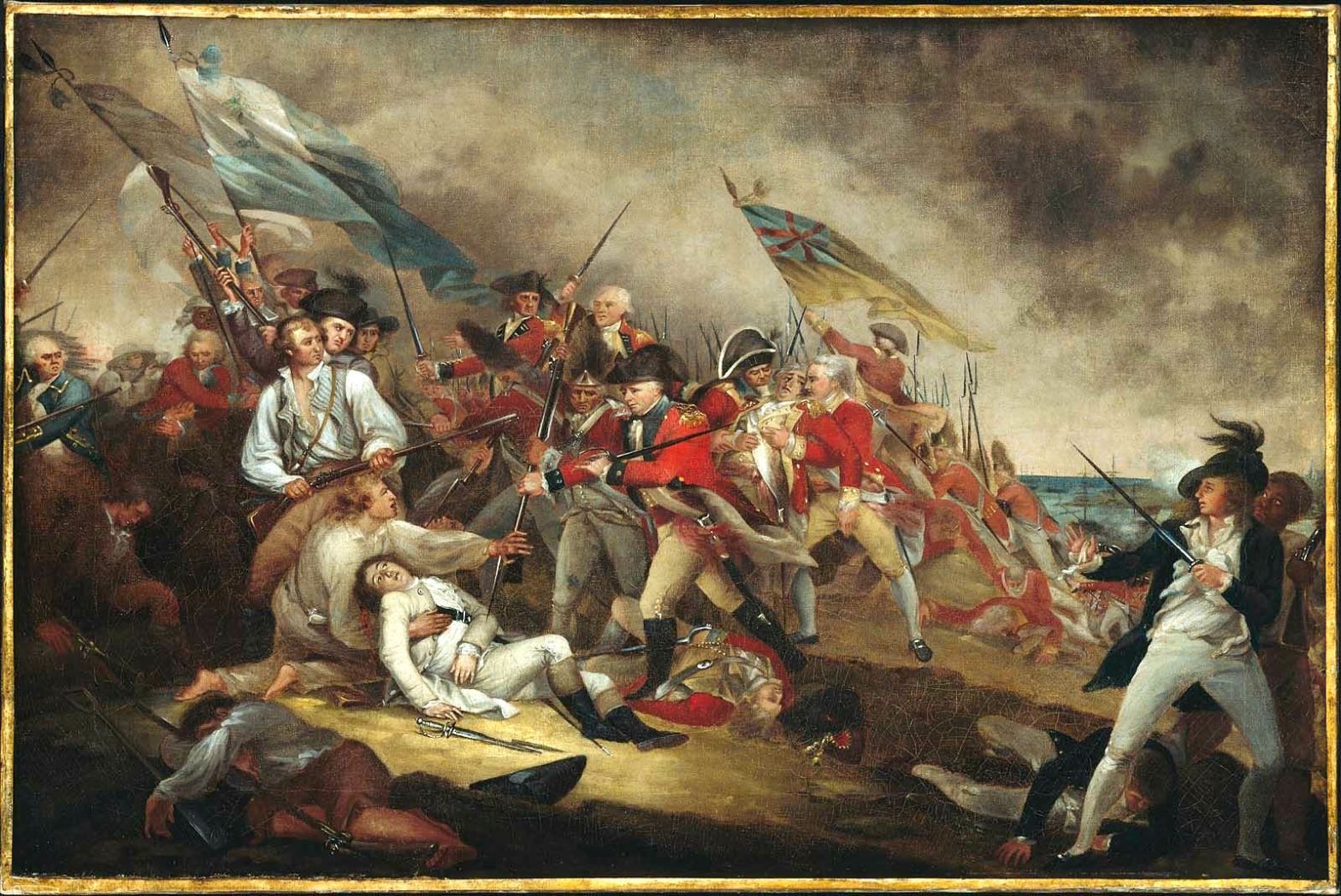
This is the story of Joseph Spaulding—an American Patriot who took part in the American Revolution right from the start. He fought at the Battle of Lexington and Concord which was the first skirmish of the war where the “shot heard round the world” was fired. But it was at the Battle of Bunker Hill where Joseph Spaulding will be forever known.
Joseph Spaulding was born on April 18, 1756 in the town Chelmsford in the Massachusetts Bay Colony. He was the son of Robert and Hazadiah (Johnson) Spaulding. Joseph’s 3rd great-grandfather, Edward Spalding, was the first to bring the family name to the American colonies in the early 1600s. Edward is my 9th great-grandfather.
The Lexington Alarm
On the evening of Joseph’s 19th birthday, the Lexington Alarm was sounded by a network of riders, most famously Paul Revere, who spread the urgent warning of advancing British troops. This ultimately led to the Battles of Lexington and Concord, marking the beginning of the American Revolutionary War.
Private Joseph Spaulding served in Captain Oliver Barron’s militia company from Chelmsford. On April 19, 1775, Barron’s unit, consisting of 61 men, marched 12 miles south to defend Concord.1 They fought the British at the North Bridge, Meriam’s Corner, and along the Battle Road back to Boston. Other Spaulding cousins serving in Captain Barron’s company were: Sergeant Silos Spaulding, Drummer John Spaulding, Benjamin Spaulding, and Henry Spaulding.2
Bunker Hill
In June 1775, following the Battle of Lexington and Concord, Private Joseph Spaulding was assigned to Captain John Ford’s Company in Colonel Ebenezer Bridge’s 27th Regiment, stationed in Cambridge.3
The Battle of Bunker Hill was just days away and Captain Ford’s men could feel it coming.
Occurring on June 17, 1775, during the siege of Boston, Bunker Hill became the first major battle of the American Revolution, and the Spaulding family was right in the middle of it all. The nine Spaulding men who fought at the Battle of Bunker Hill were: Joseph, Levi, Jonas, Eben, William, Thomas, Uriah, John, and Ebenezer.
As America began its fight for independence, the Battle of Bunker Hill emerged as a defining moment that helped frame the course of the Revolution. At the onset of the battle, colonial military leaders regularly reminded their troops to hold their fire until the moment when it would have the greatest effect. In keeping with this strategy, General Israel Putnam issued this famous order at Bunker Hill:
“Don’t fire until you see the whites of their eyes.”
—Gen. Israel Putnam, Continental Army (1775)
Apparently, Chelmsford Minuteman, Private Joseph Spaulding, thought his eyesight was better than the rest of his company, as he fired the very first shot at Bunker Hill. He was subsequently reprimanded by General Putnam for firing early. Here’s the story in Private Spaulding’s own words:
“I fired ahead of time and Putnam rushed up and struck at me for violating orders. I suppose I deserved it, but I was anxious to get another good shot at Gage’s men ever since our affair at Concord. The blow from “Old Put” hit me on the head, made a hole in my hat, and left this scar.”4
—Private Joseph Spaulding (1775)
Here’s how Joseph’s story was documented in The Spalding Memorial, written by Charles Warren Spalding in 1897.
“He [Private Joseph Spaulding] fought in the Battle of Bunker Hill, and killed the first man, a [British] lieutenant, much to his disgrace at the time. Sharpshooting was not then in repute, and his family apologized for his act as accidental. The orders were not to fire until the command was given. These he disobeyed. While the British forces were advancing, a lieutenant was in the act of jumping over a stonewall, in the direct range of the musket of Joseph. The aim was so good, the excitement and fear of losing his man so great, that a curl of the finger did the deed; then followed an irregular fire. The officer in command [General Israel Putnam] struck him a stunning blow on the head with his sword, and he was put under arrest for disobeying orders”.5
—Charles Warren Spalding (1897)
In the years following the war, Joseph Spalding, would show off the scar on his head and share his heroic stories of the American Revolution.
The Monument
There’s a picturesque monument in honor of the nine Spaulding veterans of the Battle of Bunker Hill at the Forest Lawn Cemetery in Buffalo, New York.
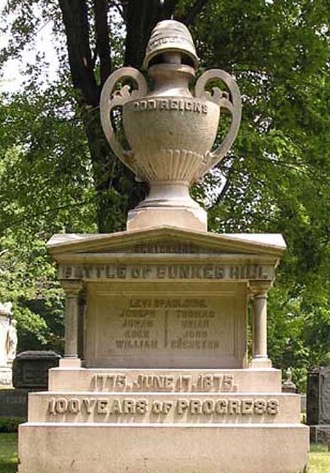
You may ask, why would a monument to an American Revolution battle fought near Boston, Massachusetts, be erected 400 miles away in Buffalo, New York? And who erected this monument on June 17, 1875— the centennial anniversary of that epic battle?
Enter Elbridge Gerry “E.G.” Spaulding (1809-1897).
The Honorable E.G. Spaulding served as mayor of Buffalo, New York, state treasurer, and a member of the 36th and 37th U.S. Congress from 1859 to 1863. While serving in Washington D.C., E.G. Spaulding was an advisor to President Lincoln.7 And apparently, he also had a passion for Spaulding family history.
E.G. Spaulding’s grandfather, Levi Spaulding, fought at Bunker Hill, which was likely his motivating factor for constructing this monument. The stone used in the monument was taken from the granite hills of New Hampshire, where E.G. Spaulding’s father and grandfather were born.7
For 150 years, E.G. Spaulding’s monument has served as a reminder to the people of western New York of the sacrifice of the nine brave Spaulding’s who fought at Bunker Hill —the first major battle of the American Revolution.
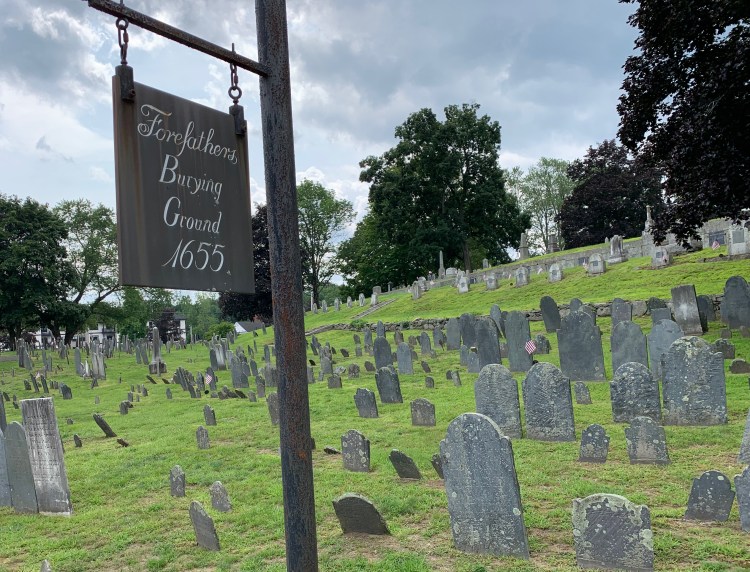
Joseph Spaulding, the American Patriot who fired the first shot at Bunker Hill, died on July 31, 1820 at age 64. He is buried in the Forefathers Burying Ground in Chelmsford, Massachusetts. He rests in peace among his ancestors who were first buried there in the 1600s.
The Spalding Memorial
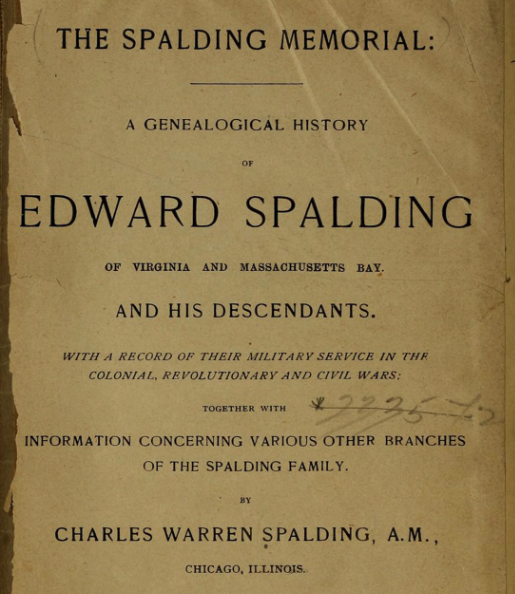
If you have Spalding/Spaulding ancestors and you’d like to add an outstanding reference to your family research library, you’ll want to get a copy of The Spalding Memorial, published by Charles Warren Spalding in 1897.
Years ago, Marti Spalding of Chelmsford, Massachusetts, had The Spalding Memorial reprinted. She still has copies for sale. I own two copies to pass on to each of my sons. If you are interested in getting your copy of this treasured Spalding/Spaulding family history book, reach out to Marti at: martis19@comcast.net.
NOTES
- American History Central. Chelmsford and the Battles of Lexington and Concord. Accessed from https://www.americanhistorycentral.com/entries/lexington-and-concord-chelmsford-militia/ on October 2, 2025.
- Coburn, F. Muster Rolls of the Participating Companies of the American Militia and Minutemen in the Battle of April 19, 1775. (Massachusetts: Eastern National Park & Monument Association, 1995), 17.
- Carlisle Historical Society, Inc. Joseph Spaulding 1756-1820. Accessed from https://www.carlisle250.org/joseph-spalding.html on October 1, 2025.
- Spalding, M. Touring the Forefathers Burying Ground. (Massachusetts: Spalding Documentation Services, Inc., 2002), 67.
- Spalding, C. The Spalding Memorial: A Genealogical History of Edward Spalding and His Descendants. (Illinois: American Publishers Association, 1897), 210.
- Image: Buffalo Architecture and History. Spaulding Veterans of the Battle of Bunker Hill Cenotaph. Accessed from https://buffaloah.com/h/spauld/index.html on October 2, 2025.
- Buffalo Architecture and History. Bio-Elbridge Gerry Spaulding (1809-1897). Accessed from https://buffaloah.com/h/spauld/index.html on October 2, 2025.
- Image: Dale Spaulding. Forefathers Burying Ground. Chelmsford, Massachusetts, 2021.
- Featured Image: Trumbull, J. 1786. The Death of General Warren at the Battle of Bunker Hill. Accessed from https://en.wikipedia.org/wiki/Battle_of_Bunker_Hill#/media/File:The_Death_of_General_Warren_at_the_Battle_of_Bunker’s_Hill.jpg on October 6, 2025. Public Domain.
Discover more from Fortitude
Subscribe to get the latest posts sent to your email.
 Fortitude
