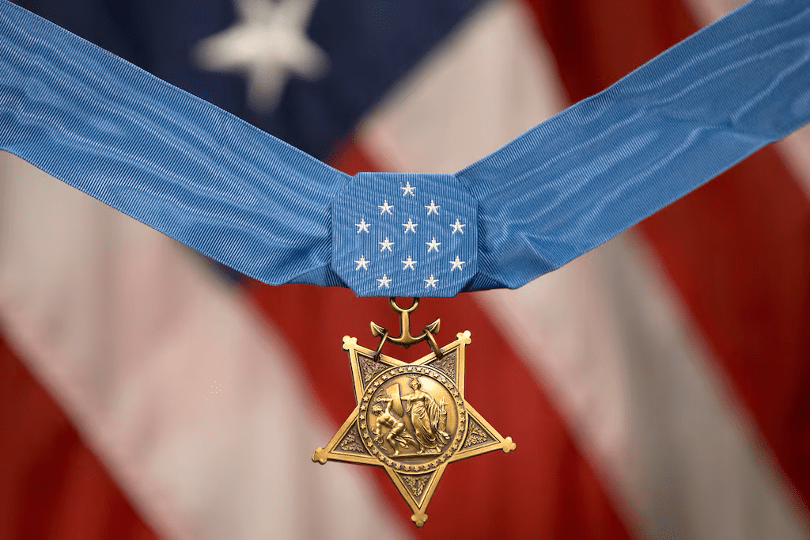
The Medal of Honor is the highest military award for valor in the United States, presented by the President to service members who distinguish themselves in combat through “conspicuous gallantry and intrepidity at the risk of life above and beyond the call of duty”.1
In this month’s Fortitude post, I delve into the history of the Medal of Honor, the opening of the National Medal of Honor Museum, and the story of a family member who earned this distinguished award.
The Medal
The Medal of Honor was first awarded during the Civil War. In July 1862, President Lincoln authorized “medals of honor” presented, in the name of the Congress, to enlisted personnel who distinguish themselves by their gallantry in action, and other soldier-like qualities.2
In July 1918, during World War I, the Medal of Honor became the highest military award, surpassing the Distinguished Service Cross, Distinguished Service Medal, and Silver Star.2
Each branch of the U.S. Armed Forces has a distinct Medal of Honor design to reflect its unique history and traditions. The Navy, Marine Corps and Coast Guard use the same medal.
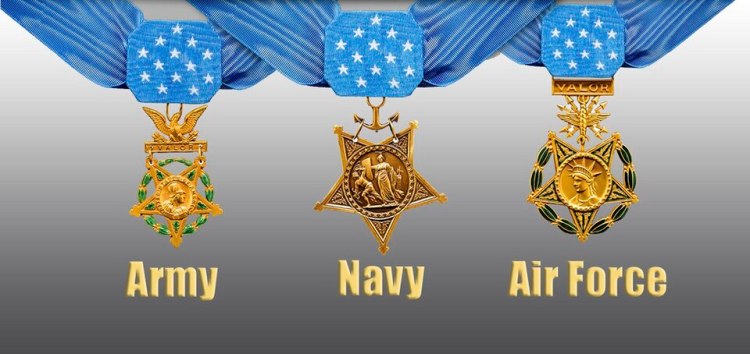
In all, more than 3,400 Army, Navy, Marine, Air Force, and Coast Guard personnel have received the Medal of Honor for action during twenty separate periods of U.S. conflict. Nineteen men received the Medal of Honor twice.2
The Medal of Honor salute is a respected tradition in the military, where uniformed service members salute recipients of the Medal of Honor. This is unique because, unlike standard protocol, a higher-ranking officer salutes the medal recipient of lower rank. This salute is directed at the medal, honoring the extraordinary courage and sacrifice it represents, rather than the recipient’s rank.
The Museum
I recently visited the National Medal of Honor Museum in Arlington, Texas. The museum opened on March 25, 2025—appropriately on National Medal of Honor Day, which is observed each year on March 25 to commemorate the awarding of the first Medal of Honor in 1863 during the Civil War.

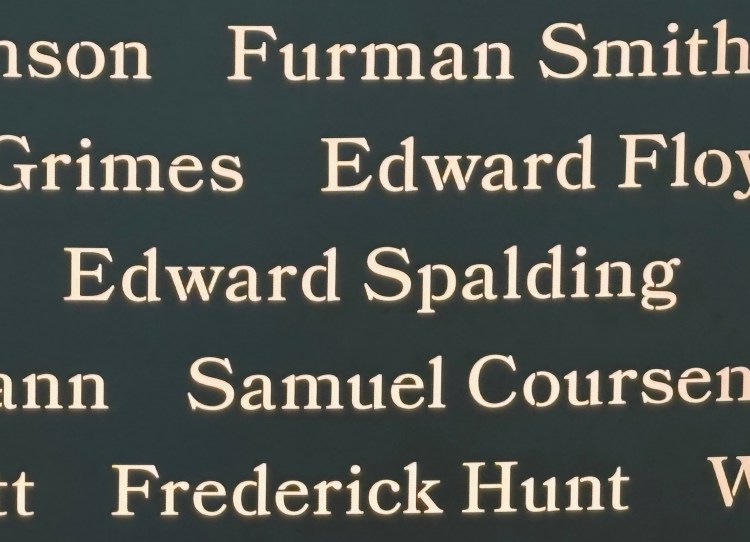
The museum’s structure appears to float 40 feet above the ground, supported by five columns, each symbolizing a branch of the United States Armed Forces. This remarkable architectural design reflects the immense responsibility borne by Medal of Honor recipients and powerfully conveys the heavy burden they carried in combat. The Ring of Valor is a circular feature inside the museum engraved with the names of every Medal of Honor recipient.3
I was struck by a deep and surreal feeling of pride as I came to attention and gazed upon Edward Spalding’s name engraved in the Ring of Valor. What follows is the account of his extraordinary heroism.
The Story
Readers of my Fortitude Blog know that I enjoy writing about history and typically spotlight a Spalding/Spaulding family member who intersected those moments of history. In the 160 years since the Medal of Honor was first awarded, only one Spalding/Spaulding has received the distinction—his name was Edward Spalding (1840-1920).
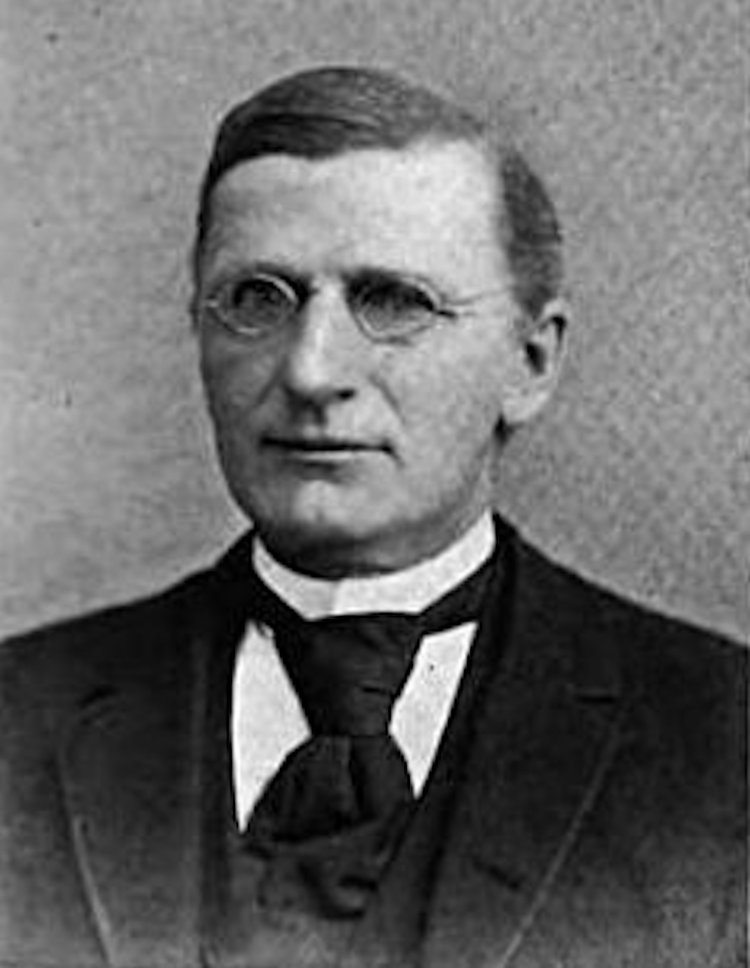
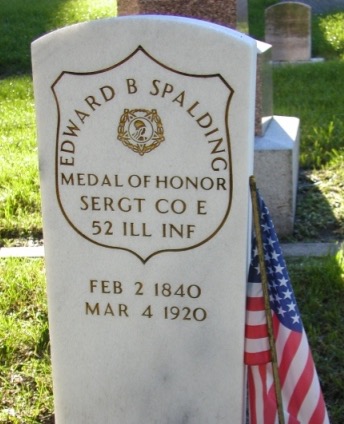
Edward Burson Spalding was born on February 2, 1840, in Byron, Illinois. He is a direct descendant of family progenitor, Edward Spalding (1601-1669), through his oldest son, John Spalding. I descend from Edward’s youngest son Andrew.
Sergeant Edward B. Spalding enlisted in the Union Army on October 1, 1861, and was assigned to Company E of the 52nd Illinois Infantry Regiment. On April 6, 1862, during the Battle of Shiloh, Sergeant Spalding was severely wounded multiple times, but he refused to leave the battlefield and continued to remain in the fight.4
My third-great uncle, Private Henry Spaulding, also fought at the Battle of Shiloh. He was assigned to Battery A of the 1st Illinois Light Artillery. Both Edward and Henry’s units were part of General Grant’s Army of the Tennessee in 1862. It’s intriguing to think if these two Spaulding’s may have crossed paths before, during, or after the intense two-day Battle of Shiloh.
Following the battle, Sergeant Edward Spalding was taken to the hospital for surgery. His health, however, was steadily failing, so as a last resort to save his life, his father, Asa G. Spalding, brought him back home. Time at home proved restorative for Sergeant Edward Spalding, and feeling sufficiently recovered, he pressed to return to duty. He rejoined his unit in late August 1862 at Corinth, Mississippi.4
Sergeant Edward Spalding’s infantry regiment commander witnessed his leadership and resilience, promoting Edward to second lieutenant on September 13, 1862. Edward was later promoted to first lieutenant on March 10, 1863. Now a company commander, Edward led his unit throughout General Sherman’s Atlanta campaign to the completion of the march to Savannah, Georgia in 1864.
On January 15, 1894, Edward Burson Spalding was awarded the Medal of Honor by Daniel S. Lamont, U.S. Secretary of War, for his conspicuous gallantry at Pittsburg Landing (Shiloh). The citation read:
The President of the United States of America, in the name of Congress, takes pleasure in presenting the Medal of Honor to Sergeant Edward Burson Spalding, United States Army, for extraordinary heroism on 6 April 1862, while serving with Company E, 52d Illinois Infantry, in action at Pittsburgh Landing, Tennessee. Although twice wounded, and thereby crippled for life, Sergeant Spalding remained fighting in open ground to the close of the battle.5
The Legacy
Edward Burson Spalding descends from a long family legacy of military service to the United States. Edward’s Grandfather, Colonel Harry S. Spalding, served in the War of 1812.
Edward’s great-grandfather, John Spalding, served in the American Revolution. At just 13 years old, John joined his father, Captain Simon Spalding, as a fifer in his company.6 In the Revolutionary War, fifers played a small, high-pitched flute that was essential to military communication. Alongside drummers, they formed fife and drum corps that transmitted commands, structured daily camp life, and lifted troop morale through specific musical signals.7 John Spalding later went on to serve as a colonel in the Pennsylvania Militia.
Edward’s 2nd great-grandfather, Captain Simon Spalding, served in the Continental Army during American Revolution operating along the Hudson River in 1781. Simon continued his military service after the Revolutionary War and was ultimately promoted to Brigadier General in the Pennsylvania Militia in 1793.8
There’s one more interesting family connection to highlight. Edward’s uncle, James Lawrence Spalding, was the father of Albert Goodwill Spalding, founder of the Spalding Sporting Goods Company. I share Albert’s compelling story in Mr. Baseball HERE.
Edward Burson Spalding, died on March 4, 1920 at age 80. He is buried in the Floyd Cemetery in Sioux City, Iowa. May we forever remember the acts of valor, extraordinary courage, and sacrifice to country made by Medal of Honor recipients like Edward Burson Spalding.
NOTES
- U.S. Department of War. Spotlight: Medal of Honor. Accessed from https://www.war.gov/Spotlights/Medal-of-Honor/on December 21, 2025.
- U.S. Department of Veterans Affairs. National Cemetery Administration. Medal of Honor History. Accessed from https://www.cem.va.gov/history/Medal-of-Honor-history.asp on January 1, 2026.
- Rafael Vinoly Architects. National Medal of Honor Museum. Accessed from https://www.rvapc.com/works/national-medal-honor-museum/ on December 21, 2025.
- Spaulding, D. Fortitude: Preserving 400 Years of an American Family’s Faith, Patriotism, Grit, and Determination.(Ohio: Gatekeeper Press, 2022), p. 192.
- Military Times Hall of Valor. Edward Burson Spalding. Accessed from https://valor.militarytimes.com/hero/734/ on January 1, 2026.
- Find a Grave. Col John Spalding. Accessed from https://www.findagrave.com/memorial/43776438/john-spalding on December 21, 2025.
- Colonial Williamsburg. Fifes and Drums. Accessed from https://www.colonialwilliamsburg.org/discover/preserving-the-past/fifes-drums/ on December 21, 2025.
- Find a Grave. General Simon Spalding. Accessed from https://images.findagrave.com/photos/2023/16/43776187_c8dd0d29-0edf-4451-91ef-80db0e1d1b9c.jpeg on December 21, 2025.
- Featured Image: Military Times. 2025. U.S. Navy Medal of Honor. Accessed from https://www.militarytimes.com/news/pentagon-congress/2025/12/03/medal-of-honor-recipients-to-receive-larger-stipends-under-new-law/ on December 23, 2025.
- Wikimedia Commons. Tri-service Medal of Honor. Accessed from https://commons.wikimedia.org/wiki/File:Tri-service_medal_of_honor.jpg on January 1, 2026.
- Image: National Medal of Honor Museum. Museum Building Photo. Accessed from https://mohmuseum.org on December 23, 2025.
- Image: Spaulding, D. 2025. Edward Spalding’s Name on Ring of Valor. National Medal of Honor Museum, Arlington, Texas.
- Image: Wikimedia Commons. 1885. Edward Burson Spalding. Accessed from https://commons.wikimedia.org/wiki/File:Edward_Burson_Spalding_1885_public_domain_USGov.jpg on December 23, 2025.
- Image: Find a Grave. Edward B. Spalding Medal of Honor Gravestone. Accessed from https://www.findagrave.com/memorial/7685075/edward_burson-spalding/photo#view-photo=960621 on December 23, 2025.
Discover more from Fortitude
Subscribe to get the latest posts sent to your email.
 Fortitude


