
Have your ever wondered about the story behind your given (or first) name? Perhaps you were named after an ancestor, or someone that your mother and father admired or respected. Have you ever considered when your given name originated? Were you named after a biblical character from long ago?
In today’s post, I’ll first explore the history behind the surname (or family name). Then I’ll take a look back at the origins of given names.
“The history of names is so ancient that no one knows the beginning of the story. Since written history began, and as far back as oral history reaches, people have had names. It is therefore impossible to do more than guess at how the earliest given names were chosen.”1
Surnames
According to Robert Ferguson in Surnames as a Science (1883), the forming of surnames in England dates back to Anglo-Saxon times.
Early examples of surnames began to appear in 11th century England. Biblical given names such as John, Paul, and Elizabeth were so prolific that a need arose for a method to further distinguish individuals. Additionally, the English government needed a method of positive identification as it began leveeing personal taxation, known then as the Poll Tax.
Surnames were first taken from an identifying aspect of an individual, such as a trade, father’s name (son of), physical features, or location of birth. Here are the common sources of surnames.
Trade Surnames: Derived from a person’s occupation. Examples: Taylor, Carpenter, Cook, Shoemaker, Goldsmith.
Patronymic Surnames: Derived from adding “son” to the given name of one’s father (son of). Examples: Williamson, Johnson, Robertson, Carlson, Richardson.
Characteristics Surnames: Based on an adjective to describe one’s physical features. Surnames used to describe a person’s size (Short, Long, Little), coloring (Black, White, Gray), or other character trait (Stern, Strong, Swift).2
Toponymic Surnames: Derived from the peron’s place of origin, land they held, or from topographic features of the area. Examples: Spalding, Hamilton, London, Montgomery, Newton.
By 1400, most people of British descent had surnames. It’s extremely challenging to trace one’s ancestral lineage to periods of history preceding the introduction of surnames with the given name as the only identifier.
Given Names
The term given, or first name, refers to a name bestowed (given) at the time of birth. Given names are used in familiar, informal, and friendly situations. Whereas, the surname is more commonly used in a formal setting. This familiarity setting of the given name is where the expression, “we’re on a first-name basis” comes from.
Most given names are grouped into categories based on their origin.
Hebrew Names: Names with Hebrew origins, especially those from the Bible, are commonly used by Jews and Christians. Many of these names have been adapted from Hebrew phrases and expressions. Examples: Adam, Michael, Joshua, Daniel, Joseph, David, Elizabeth, Hannah, Mary.
Greek Names: Names with ancient Greek origins are derived from the period of Classical Antiquity between the 8th century BC and the 5th century AD. Such names are often made English (anglicized). Examples: Helen, Chloe, Alexander, Zoe, Leon, Gregory, Sophia.3
Germanic Names: Names with German origins are frequently warlike in name with root meanings of glory and strength. Germanic given names are oftentimes dithematic (having two elements). For example, the given name Gerhard is formed with the elements Ger (meaning spear) and Hard (meaning brave).4 Examples: Robert, Wilhelm, Edward, Alfred.
Trait Names: Trait names are based on virtues that a parent may desire their child will grow to emulate. Many trait names have biblical origins. Examples: Grace, Faith, Hope, Charity, Joy.
Biblical Origins
As you ponder the origins of your given name, you may be surprised just how far back your name may go. For example, when I think of my 7th great-grandmother, Abigail, I first surmised its origin from 15th century England. In reality, her name originated thousands of years ago in Old Testament biblical times with Hebrew roots in 500 BC.
Let’s take a look back at the given names of a few of my ancestors to discover their biblical origins. Perhaps one of your ancestors had the same given name?
Rachel: Rachel (Needham) Spalding (1622-1670) was my 9th great-grandmother. The biblical character Rachel is first mentioned in Genesis 29. Rachel was the wife of Jacob (son of Isaac and grandson of Abraham). Rachel was the mother of Joseph and Benjamin, two of the namesakes of the 12 tribes of Israel.
Andrew: Andrew Spaulding (1652-1713) was my 8th great-grandfather. Andrew was an apostle of Jesus. Andrew and his brother Simon Peter were fisherman on the Sea of Galilee. In Matthew 4, the two brothers were called to become disciples of Jesus and “fishers of men”.
Hannah: Hannah (Jefts) Spaulding (1654-1730) was my 8th great-grandmother. In the Old Testament, Hannah was the wife of Elkanah. Hannah desperately desired a child but could not conceive. Hannah cried out to God about her situation. She promised the Lord that if He would give her a son, she would dedicate him to God. First Samuel, chapter 2 records that Hannah’s prayers were answered when she gave birth to a son named Samuel whose named meant “asked of God”.
Abigail: Abigail (Warren) Spaulding (1682-1768) was my 7th great-grandmother. In the Old Testament, Abigail was the wife of Nabal of southern Judah. After Nabal died, Abigail became the third wife of King David (1 Samuel 25) and born him a son named Chileab. The name Abigail was also given to one of King David’s sisters (1 Chronicles 2:16).
James: James Spaulding (1714-1790) was my 6th great-grandfather. There are three men named James documented in the Gospel of Matthew. James, the half-brother of Jesus Christ, James son of Zebedee and brother of John, and James, son of Alphaeus. James, the half-brother of Jesus was the author of the Epistle of James written between A.D. 50 and A.D. 60. After the death and resurrection of Jesus, James became the leader of the early church in Jerusalem.
Anna: Anna (Underwood) Spaulding (1717-1770) was my 6th great-grandmother. Anna is documented in the Bible as a prophetess (Luke 2:36) and connected to Jesus’ childhood. When Anna encounters the baby Jesus in the temple, we see that her life is one of favor and grace. After becoming a widow, Anna dedicated herself to the Lord spending her days worshiping, fasting, and praying at the temple in Jerusalem (Luke 2:37).
Benjamin: Benjamin Spaulding (1738-1810) was my 5th great-grandfather. Benjamin was a son of Jacob and head of one of the 12 tribes of Israel. Benjamin was the twelfth-born and youngest son in Jacob’s family (Genesis 35). The story of Benjamin and the tribe of Benjamin is contained in the Old Testament books of Numbers, Deuteronomy, Joshua, and Judges. Descendants of Benjamin include King Saul (Israel’s first king) Queen Esther (from the Old Testament book of Esther) and the Apostle Paul.
Sarah: Sarah (Chandler) Spaulding (1739-1796) was my 5th great-grandmother. In the Old Testament, Sarah was the wife of Abraham. Sarah was childless until she was 90 years old. God promised Abraham that Sarah would be “a mother of nations” (Genesis 17:16). Isaac was born to Sarah and Abraham in their old age as the fulfillment of God’s promise to them.
Jesse: Jesse Spaulding (1772-1858) was my 4th great-grandfather. In the Old Testament, Jesse was the father of King David, Israel’s most famous king. King David was the youngest of Jesse’s eight sons. Jesse is listed in the genealogy of Jesus (Matthew 1). The New Testament documents that Jesus came from the linage of Jesse’s son, King David (Matthew 22) as prophets declared in the Old Testament.
Mary: Mary Esther (Renfro) Spaulding (1843-1918) was my 2nd great-grandmother. The given name, Mary, is found multiple times in the New Testament. In fact, Mary was the most popular name amongst Hebrew women in the 1st century during the times of Jesus Christ. Women of the Bible named Mary include: Mary, the mother of Jesus and Mary Magdalene, a close follower of Jesus who was an eyewitness to his crucifixion and resurrection.
Origins of Your Given Name
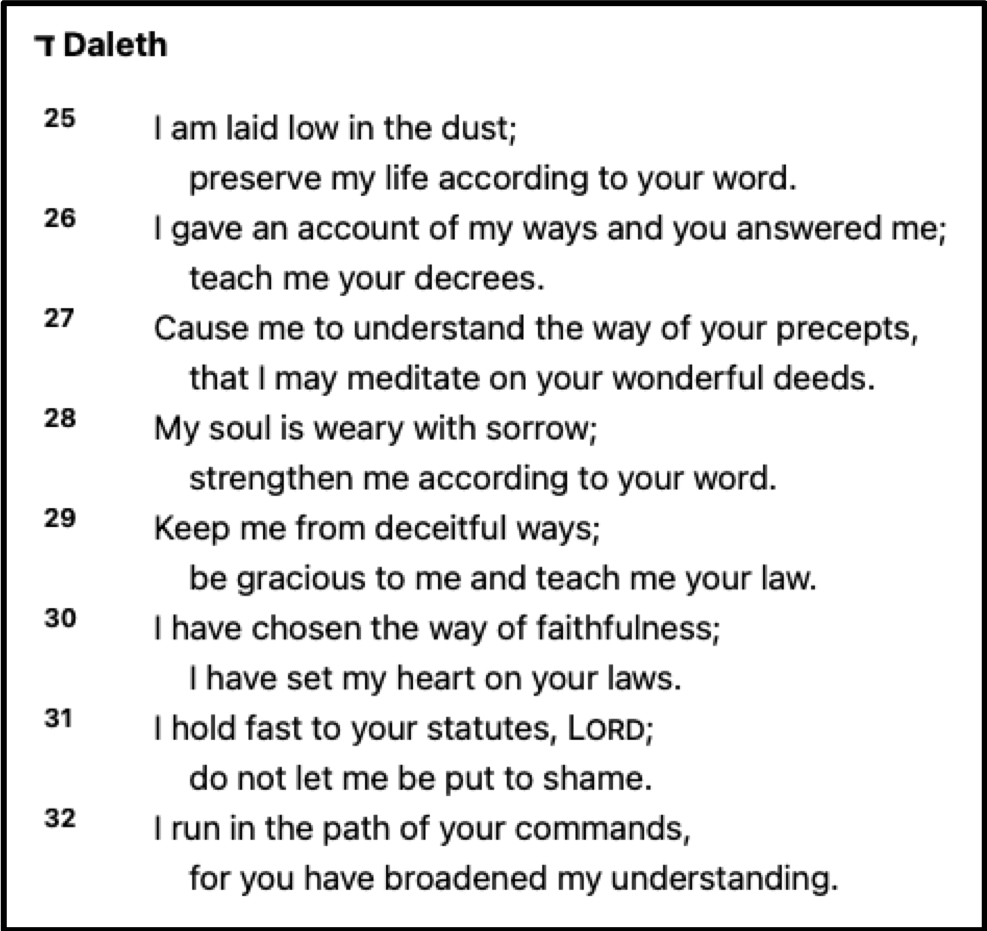
When I searched for my given name “Dale”, I didn’t find any biblical characters. But, I did discover something interesting – the letter “Dalet”. Dalet is 4th letter of many ancient Semitic alphabets (Phoenician, Aramaic, Hebrew, and Arabic). The Hebrew word for the portion of the Bible containing Psalm 119:25-32 is “Daleth”, which means “door” as the hieroglyph of the letter Dalet looks like a door (or gate).5
Curious to see if your given name (or the names of your ancestors) have biblical origins? Click HERE for the Bible Gateway, an online source for multiple versions of the Bible. Then, search for your given name and see what you discover!
Your Family History Narrative

If you’ve been studying your family history and wondering how to preserve what you’ve learned for future generations, you may want to check out my book Fortitude: Preserving 400 Years of an American Family’s Faith, Patriotism, Grit and Determination. I hope my book will encourage you on your family history discovery journey. Click HERE to learn more.
Sources
- Scolastica la souriete, © Elliott, K. (1997). A Brief Introduction to the History of Names. Accessed from https://heraldry.sca.org/names/namehist.html on April 22, 2023.
- Ancestry. What does your name say about you? Accessed from https://blogs.ancestry.co.uk/cm/there-are-7-types-of-english-surnames-which-one-are-you-mobile/ on April 14, 2023.
- Kihm, S. (2022). Ancient Greek Names. Accessed from https://nameberry.com/list/691/ancient-greek-names on April 15, 2023.
- Behind the Name. Germanic Names. Accessed from https://www.behindthename.com/glossary/view/germanic_names on April 15, 2023.
- Tanyaremkiv. Psalm 119:25-32 | Daleth. Accessed from https://tanyaremkiv.com/2020/07/27/psalm-11925-32-daleth/ on April 22, 2023.
Discover more from Fortitude
Subscribe to get the latest posts sent to your email.
 Fortitude
Thanks Dale. I had no idea.
Patrick: from the Latin name Patricius, which meant “nobleman”.
LikeLike