
This is the fourth and final post in a series on the American Civil War. In this series, I described the three combat arms used during the Civil War to accomplish military objectives (cavalry, infantry, and artillery) to include the story of a Spaulding family member who served in each of these roles. In this final post of the series, I’ll examine the role of the Civil War chaplain.
You can read the first post on the Civil War cavalryman HERE, the second post on the Civil War infantryman HERE, and the third post on the Civil War artilleryman HERE.
The Civil War Chaplain

Chaplains for Union forces were established by General Orders 15 and 16 from the U.S. War Department on May 4, 1861. Approximately 3,700 chaplains were appointed by the Union and Confederacy during the Civil War. The denominational backgrounds of chaplains during the Civil War were: Methodist (41%), Presbyterian (18%), Baptist (14%), Episcopal (10%), Congregational (7%), Unitarian (3%), and Roman Catholic (3%).1
Union Army chaplains were assigned the rank (and pay) of a captain with $100 per month and $18 for rations. They were provided a tent, and feed for a horse, which the chaplain had to provide. Chaplains wore no rank and did not carry a weapon. Chaplains in the Confederacy did not fare as well as their Union counterparts, as most them did not get paid at all.2
Civil War chaplains served in the field providing encouragement and comfort to the warfighters. Chaplains also cared for the sick and wounded in hospitals. They cared for the spiritual well-being of the troops by holding Sunday worship services, prayer meetings, and Bible studies. Chaplains provided comfort for the dying and led funeral services for those who gave their last full measure of devotion for their country.3
Chaplains also cared for their men in practical ways by writing letters home for those too injured to hold a pen. By being at the side of a dying solider, and recording his last words, chaplains provided a small measure of comfort for grief-stricken families. Chaplains performed last rites for the dying and conducted funerals for those who succumbed to their wounds. Civil War chaplains frequently relayed the final words spoken by a solider to their families back home.4
Although not warfighters, Civil War chaplains were eyewitnesses to the carnage of war seeing with their eyes the gruesome wounds of combat and hearkening with their ears the screams of the dying – sights and sounds they never forgot.4
The Story

Samuel J. Spalding was born on December 11, 1820 in Lyndeborough, New Hampshire. He graduated from Dartmouth College in 1842 at age 21. He then attended Andover Theological Seminary receiving his Doctor of Divinity in 1845. Reverend Samuel J. Spalding was ordained on October 28, 1846. Following his ordination, Reverend Spalding pastored the Salmon Falls Church in Salmon Falls, New Hampshire from 1846 to 1851. He then pastored Whitefield Congregational Church in Newburyport, Massachusetts for 33 years from 1851 to 1884.5
Dr. Samuel J. Spalding is remembered today for his tireless efforts in researching and publishing The Spalding Memorial in 1872. This book is a 270-year genealogical history of Edward Spalding (1601-1679) of the Massachusetts Bay Colony and his descendants. I own an original printing of this book from 1872 which is a treasured artifact of my family history.
Reverend Spalding was a valued member of his community as a pastor, leader in the New England Historical and Genealogical Society, and one of the Trustees of the Newburyport Public Library.5 He loved his country and was called upon to read George Washington’s Farewell Address at a town celebration of the centennial anniversary of Washington’s birth on February 22, 1832. After President Lincoln was assassinated in 1865, Reverend Spalding made a special address at a memorial service in Newburyport.
Civil War Service
Reverend Samuel J. Spalding served as a Chaplain during the Civil War. He took a leave of absence as senior minister of Whitefield Congregational Church and was commissioned Chaplain in the Union Army on December 27, 1862 at age 42. Two days later, he mustered into the 48th Massachusetts Infantry Regiment. Chaplain Spalding’s regiment was assigned to the 1st Division of the Army of the Gulf under the command of Major General Christopher C. Auger.6
Chaplain Spalding served with his regiment at the battle of Plains Store at East Baton Rouge Parish, Louisiana in May 1863. He participated in the siege of Port Hudson, Louisiana from May to July 1863 which was the final Union campaign to recapture the Mississippi River. Chaplain Spalding’s unit fought at the second battle of Donaldsonville in Ascension Parish, Louisiana in June 1863.6
On September 3, 1863, Chaplain Samuel J. Spalding mustered out of the Union Army at Camp Lander in Wenham, Massachusetts. He then returned home to Newburyport to reassume duties as senior minister of the Whitefield Congregational Church. Following the Civil War, Reverend Spalding joined the Grand Army of the Republic (GAR) post 49 in Newburyport. He served as Chaplain for this post of Civil War veterans.6
The Diary

Thanks to new connections with distant Spaulding cousins, I recently became aware of the Civil War diary of Sergeant DeWitt C. Spaulding, Company G, 8th Michigan Infantry. I plan to tell DeWitt’s monumental story in a future post. An examination of DeWitt’s diary shows that Sunday church services in the field were customary during the Civil War. Here are a few entries from his diary:7
Sunday, October 6, 1861: Review and inspection. Sermon by Chaplain at 4 pm. Text from 2 Peter, 3rd chapter, 14th verse in the evening prayer meeting.
Sunday, October 13, 1861: Preaching by Chaplain Elder Mahon at 4 pm. Text from St. Mark 12th chapter, 3rd verse. The PA regiment and ours form together for church. After church we listened to a very good temperance lecture.
Sunday, October 27, 1861: The Chaplain of the 79th NY Regiment held divine service at 11 am.
Sunday, January 19, 1862: A foggy morn. Co. inspection on Co. ground at 9 am. Church at 2 pm by our Chaplain. Text from Romans 12th chapter and 12th verse.
The scripture reference from Romans 12:12 in Sergeant DeWitt Spaulding’s diary on January 19, 1862 says: “Be joyful in hope, patient in affliction, faithful in prayer.” I can only imagine how this sermon and these words penned by the Apostle Paul encouraged the troops that cold January Sunday during the Civil War.
Final Thoughts
This concludes my series of posts on the American Civil War describing the roles of cavalry, infantry, artillery and chaplaincy with stories of Spaulding family members serving in each of these roles. As you study history, try to personalize it by discovering how your ancestors intersected those moments of history. And most importantly, preserve those findings and pass them on to your descendants.
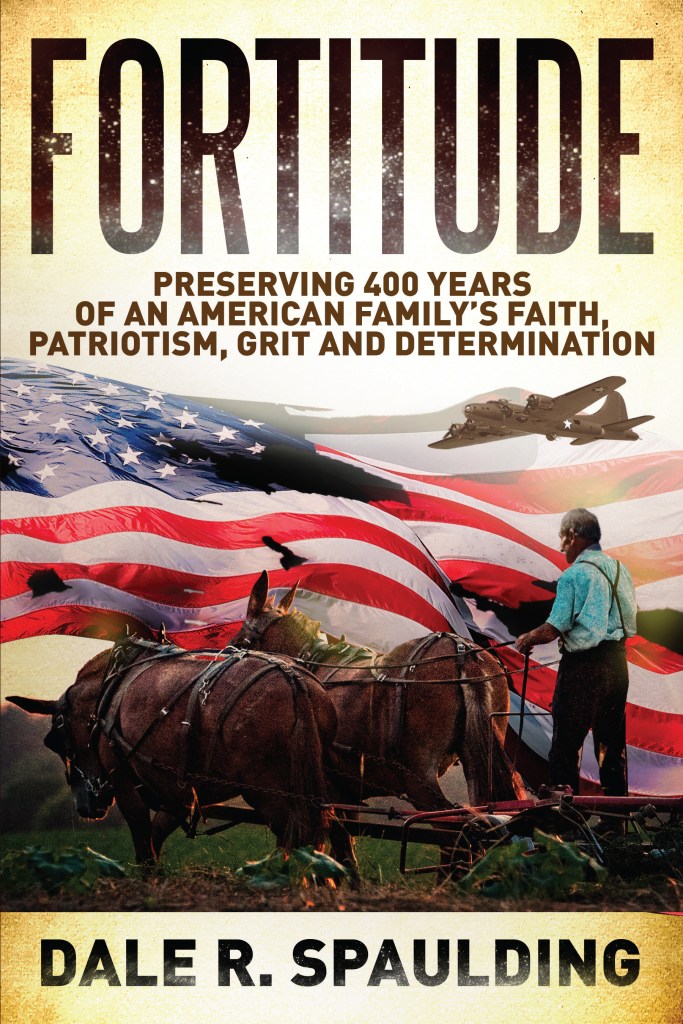
If you’d like to read more of the compelling story of Rev. Samuel J. Spalding and other patriots like them that have been part of the fabric of America since its inception, please check out my book Fortitude: Preserving 400 Years of an American Family’s Faith, Patriotism, Grit and Determination HERE.
Two years ago this month, I created the Fortitude blog. I’ve enjoyed writing about history and how Spaulding family members intersected that history. If you’d like to explore previous posts or subscribe to the monthly Fortitude blog, click HERE.
NOTES
- Presbyterian Heritage Center. Chaplaincy. Accessed from https://phcmontreat.org/Exhibit-CWChaplains-Chaplaincy.html on August 19, 2023.
- Emerging Civil War. The Absolution at Gettysburg. Accessed from https://emergingcivilwar.com/2014/04/15/the-absolution-at-gettysburg/ on August 19, 2023.
- National Archives. Faith on the Firing Line: Army Chaplains in the Civil War. Accessed from https://www.archives.gov/publications/prologue/2016/spring/chaplains.html on August 19, 2023.
- National Museum of Civil War Medicine. Civil War Chaplains. Accessed from https://www.civilwarmed.org/chaplains/ on August 19, 2023.
- Spalding, Samuel J. The Spalding Memorial: A Genealogical History of Edward Spalding, of Massachusetts Bay, and His Descendants. (Massachusetts: Alfred Mudge & Son, Printers, 1872, pp.785-788.
- Spaulding, Dale R. 150th Anniversary of The Spalding Memorial. Accessed from https://dalespaulding.com/2022/09/20/150th-anniversary-of-the-spalding-memorial/ on August 19, 2023.
- Spaulding, DeWitt C. Civil War Diary (August 15, 1861 – July 14, 1864). Transcription by Clare M. Cory, great-great granddaughter, 2011.
IMAGES
- Feature Image: Library of Congress. 9th Massachusetts Infantry and chaplain at Camp Cass, VA. (1861). Library of Congress. Accessed from https://chaplainkit.files.wordpress.com/2014/04/men-of-an-irish-american-regiment-and-their-chaplain-pause-before-celebrating-mass-at-camp-cass-virginia.jpg on August 20, 2023.
- Library of Congress. Sunday Mass with 69th New York State Militia at Fort Corcoran, VA before Battle of First Manassas (1861). Accessed from https://commons.wikimedia.org/wiki/File:69th_New_York_at_church.jpg on August 21, 2023.
- Find-a-Grave. Samuel Jones Spalding. Accessed from https://www.findagrave.com/memorial/85285212/samuel-jones-spalding on August 21, 2023.
- Potter & Potter Auctions. Diary of DeWitt C. Spaulding. Accessed from https://auctions.potterauctions.com/important_diary_of_a_civil_war_soldier_while_incar-lot10793.aspx on August 21, 2023.
Discover more from Fortitude
Subscribe to get the latest posts sent to your email.
 Fortitude


Really appreciate these stories, very vivid and moving. Makes me wonder, if, as a Spaulding, I would have the Fortitude of our ancestors. The descriptions of the military units and especially the artillery men were helpful. The logistics of war fascinate me! Thank you for doing this.
LikeLiked by 1 person