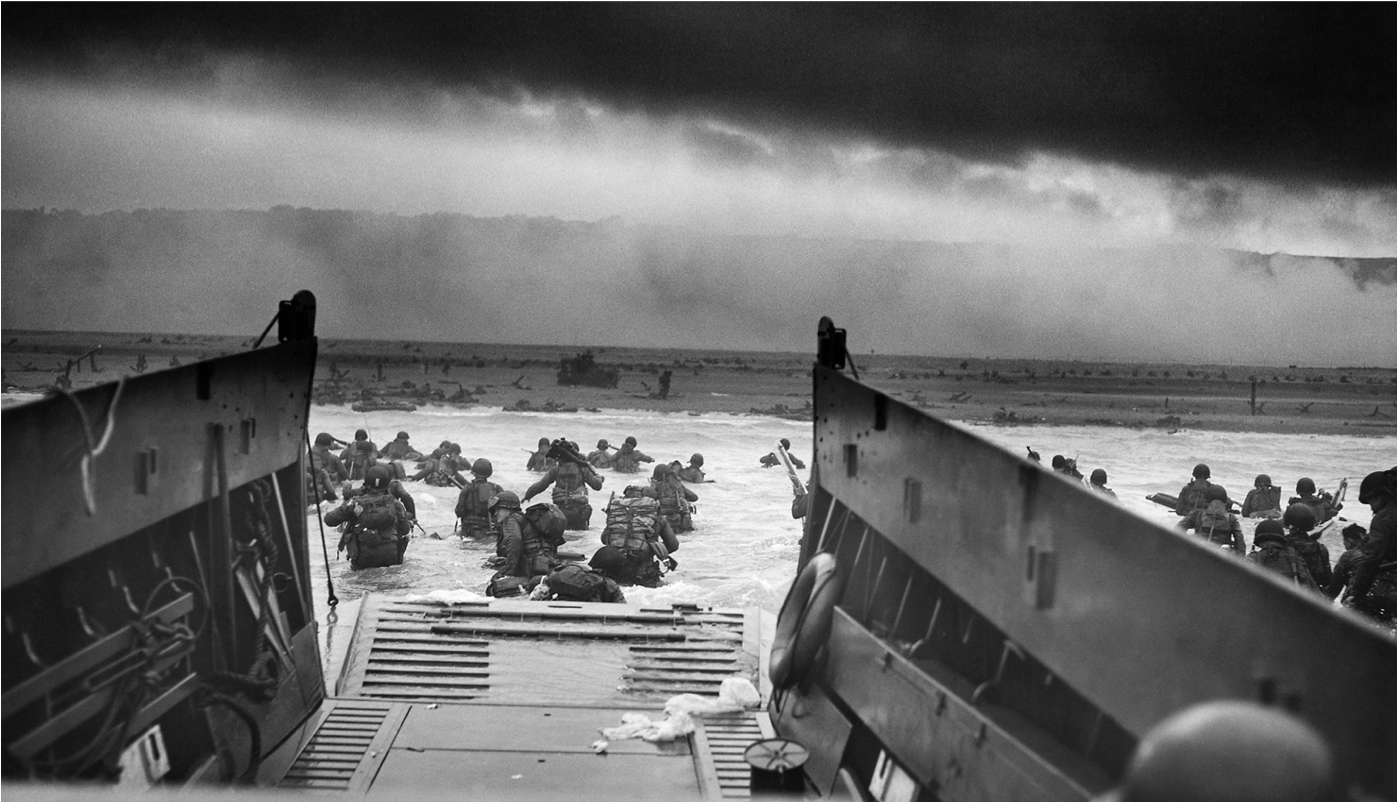
The Purple Heart is a military decoration awarded to U.S. Armed Forces personnel wounded or killed in action. The Purple Heart is the nation’s oldest military award first introduced by General George Washington in August 1782 as the “Badge of Military Merit” towards the end of the American Revolution. Inexplicably, Washington’s Badge of Military Merit was not used during the Civil War or World War I. In 1931, General Douglas MacArthur was determined to revive this historic medal.1
On the 200th anniversary (February 22, 1932) of George Washington’s birth, the U.S. War Department proclaimed the establishment of the Purple Heart with the following General Order:2
By order of the President of the United States, the Purple Heart established by General George Washington at Newburgh, August 7, 1782, during the War of the Revolution, is hereby revived out of respect to his memory and military achievements.
By Order of the Secretary War
Douglas MacArthur, General
Chief of Staff
The Medal

U.S. Army regulations specified the front side of the medal to be an enameled heart, purple in color, with the profile of General George Washington in his Continental Army uniform. Above the enameled heart is Washington’s family coat of arms between two sprays of leaves. The reverse side of the medal contains a raised bronze heart bearing the inscription “For Military Merit”. The Purple Heart is ranked immediately behind the Bronze Star and ahead of the Defense Meritorious Service Medal in order of precedence.1
For decades, recipients of the Purple Heart were honored with medals originally forged during World War II. These were leftover stock from preparations for the invasion of Japan with expected causalities of hundreds of thousands of Americas. The Truman Library Institute estimated that 495,000 Purple Heart medals remained in stock after World War II. These medals would go on to be awarded to service members and families through the Korean and Vietnam Wars. Stockpiles of these medals intended for their great-grandfather’s generation are still being refurbished and used today.3
The Criteria
The Purple Heart is awarded in the name of the President of the United States to members of the Armed Forces. The Purple Heart is limited to members of the U.S. Armed Forces who, while serving under component authority, have been wounded, were killed, or subsequently died of wounds received in action against an enemy of the United States.4
Examples of enemy-related injuries that justify award of the Purple Heart include:4
- Injury caused by enemy bullet, shrapnel, or other projectile created by enemy action
- Injury caused by enemy placed mine or trap
- Injury caused by enemy released chemical, biological, or nuclear agent
- Injury caused by vehicle or aircraft accident resulting from enemy fire
- Concussion injuries caused as a result of enemy generated explosion
The Stories
If you’ve read previous posts of the Fortitude Blog, you know that I typically write about history. I particularly value telling stories of Spaulding family members who have intersected those moments of history. Below are but a few of the Spaulding stories of Purple Heart valor from World War II, Korea, and Vietnam.5
Name: Charles A. Spaulding
Rank: Staff Sergeant
Home State: Nevada
Branch of Service: U.S. Army Air Corps
Conflict: World War II
Unit: 544th Bomber Squadron (Heavy)
Date of Incident: 09 Oct 1943
Status: Missing in Action (North Sea)

Details: Staff Sergeant Charles A. Spaulding served as a Waist Gunner aboard the B-17 Flying Fortress. On his 8th combat mission to bomb enemy aircraft factories in Anklam, Germany, SSGT Spaulding’s B-17 was struck by enemy aircraft fire. They were last observed 50 miles off the Danish coast with the vertical rudder severely damaged. The aircraft was having difficulty maintaining level flight and still under attack by enemy aircraft. Pilot 2nd Lt. John Ingles was forced to ditch the aircraft into the North Sea.6 The crew is listed on the Tablets of the Missing at the Cambridge American Cemetery in Cambridge, England.
Name: Russell F. Spaulding
Rank: Lieutenant Junior Grade
Home State: Michigan
Branch of Service: U.S. Navy
Conflict: World War II
Unit: USS Ommaney Bay (CVE-79)
Date of Incident: 04 Jan 1945
Status: Missing in Action (Sulu Sea)

Details: While steaming in the Sulu Sea, southwest of the Philippines, USS Ommaney Bay (CVE-79) was attacked by an enemy dive bomber. Two bombs were dropped – one penetrated the flight deck detonating below which set off a series of explosions among the fully-fueled aircraft. The second bomb passed through the hanger deck rupturing the fire main on the second deck, and exploded. USS Ommaney Bay (CVE-79) was so severely damaged that the order to abandon ship was given and 95 crewman were lost. The ship was scuttled later that evening by the USS Burns (DD-588).7 LTJG Russell F. Spaulding is listed on the Walls of the Missing at Manila American Cemetery, Philippines.
Name: Leon E. Spaulding
Rank: Corporal
Home State: Michigan
Branch of Service: U.S. Army
Conflict: World War II
Date of Incident: 17 Dec 1944
Status: Wounded in Action / POW (Battle of the Bulge)

Details: The Battle of the Bulge (Dec 1944 – Jan 1945) took place in the densely-forested Ardennes region between Belgium and Luxembourg. It was the bloodiest battle for U.S. forces during World War II. During the battle, marked by vicious fighting in freezing temperatures, the U.S. suffered over 80,000 casualties to include over 19,000 killed in action and more than 23,000 taken prisoner. During the Battle of the Bulge, Corporal Leon B. Spaulding was wounded in action and taken prisoner of war.8
Name: Roger C. Spaulding
Rank: Sergeant
Home State: Indiana
Branch of Service: U.S. Marine Corps
Conflict: World War II
Unit: Company G, 2nd Battalion, 4th Marine Regiment
Date of Incident: 25 May 1945
Status: Wounded in Action (Okinawa)
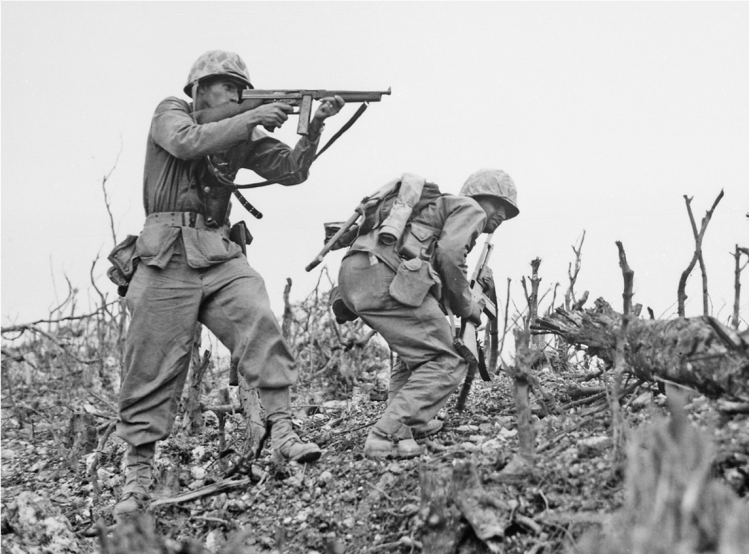
Details: The U.S. invasion of Okinawa during World War II began on April 1, 1945. By the time Okinawa was captured by American forces in late June 1945, the U.S. had sustained over 49,000 casualties including more than 12,500 men killed or missing. One of the most well-known heroics from Okinawa was that of conscientious objector (and Army medic) Private Desmond Doss, depicted in the movie Hacksaw Ridge (2016).9 Sergeant Roger C. Spaulding was wounded in action on May 25, 1945 during the heat of the Battle of Okinawa. Within the next two months, he returned to his unit leading his men in Tokyo, Japan. Their mission was to neutralize enemy guns surrounding Tokyo Bay that may endanger the battleship USS Missouri (BB-63) as she entered port for the signing of the Instrument of Surrender to end World War II.
Name: Warren W. Spaulding
Rank: Private First Class
Home State: New York
Branch of Service: U.S. Army
Conflict: Korean War (Kansas Line)
Unit: Company M, 3rd Battalion, 21st Infantry Regiment
Date of Incident: 03 Aug 1951
Status: Killed in Action

Details: The Korean War allied summer-fall offensive began in July 1951. Much of the fighting took place in North Korea above the “Kansas Line” (a line in the Korean Peninsula about 15 miles north of the 38th parallel). During this fighting, Private First Class Warren W. Spaulding was killed in action by enemy small arms fire. His casualty report read as follows: Hostile, died outright, small arms fire, ground casualty. PFC Spaulding received the Purple Heart posthumously for his actions on that day.
Name: Dean F. Spaulding
Rank: First Lieutenant
Home State: Florida
Branch of Service: U.S. Army
Conflict: Vietnam War
Unit: Battery B, 2nd Battalion, 40th Field Artillery, 199th Infantry Brigade
Date of Incident: 15 Dec 1968
Status: Killed in Action (Hua Nghia)

Details: First Lieutenant Dean Spaulding was the U.S. Field Artillery Unit Commander of Battery B of the 40th Field Artillery. In November of 1968, he deployed to Vietnam. Just six weeks later, First Lieutenant Spaulding was killed in action during combat operations in Hua Nghia. Hua Nghia is a former province in South Vietnam located west of Saigon near the border of Cambodia.
The Purple Heart That Never Was
There’s another story of heroism I’d like to share that’s a bit more personal to me. It’s the story of my uncle, Staff Sergeant George Robert “Bob” Spaulding, U.S. Army Air Corps. During World War II, he was assigned to the 301st Bombardment Group, 419th Bomb Squadron serving as an aerial gunner and radio operator aboard the B-17 Flying Fortress. My Uncle Bob flew 50 combat missions, totaling over 240 hours with the 8th Air Force out of England, 15th Air Force out of Italy, and the 12th Air Force out of North Africa.
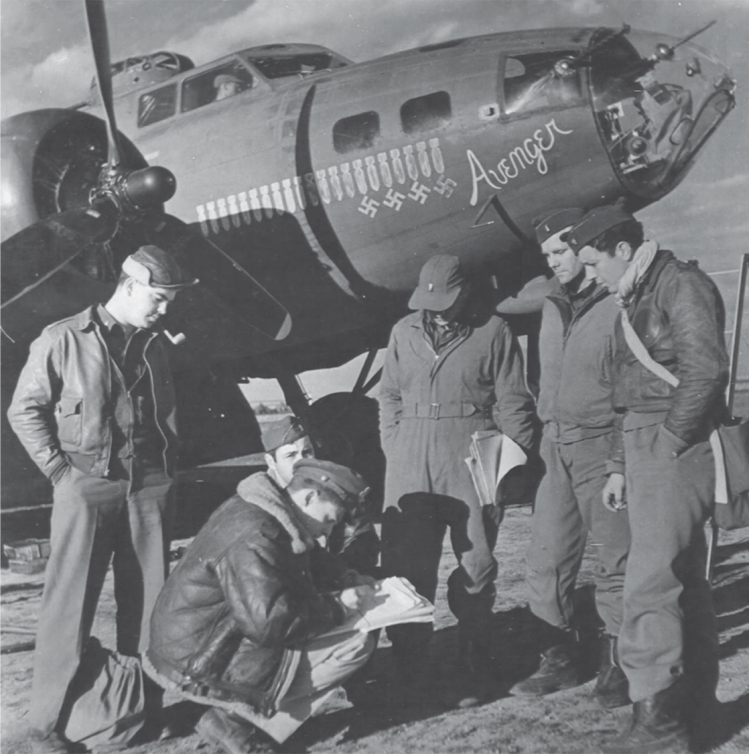
On one particular mission, SSGT Spaulding was wounded by shrapnel from a burst of flak from German anti-aircraft artillery. He was never awarded the Purple Heart. Why? Because he didn’t want attention drawn to his stated “embarrassment” of being wounded in the buttocks. On that fateful day, after his crippled aircraft returned to base, he refused medical care. His fellow crew members poured a bottle of booze on his derriere and proceeded to use pliers to pull shards of shrapnel from his back side. No doctors – No report of being wounded in action – and No Purple Heart – which was exactly how my Uncle Bob wanted it!
Final Thoughts
My 9th great-grandfather, Edward Spalding (1601-1669), of the Massachusetts Bay Colony, was the first to bring the Spalding/Spaulding surname to America. He would be grateful to know that so many of his descendants served and scarified with valor to defend the country he helped establish.
I can only imagine the pride previous generations of Spaulding’s who fought in the American Revolution, Civil War, and World War I would have felt knowing that future Spaulding’s would follow in their footsteps. The accounts of bravery contained in this post capture but a few of those stories. Some gave their last full measure of devotion with their ultimate sacrifice for our country, some bled on the battlefield, and recovered from their wounds – all received the honor bestowed by the Purple Heart medal.
Related Reading from the Fortitude Book/Blog
- Fortitude book published in May 2022
- Memorial Day – The Dash in the Middle posted on May 16, 2023
- Sons of Liberty posted on March 15, 2022
- Letters Home From a B-17 Crewman posted on October 18. 2022
- The Last Soldier posted on February 15, 2023
- Veterans Day Reflections posted on November 8, 2022
- Repatriation: The Bodies of War posted on May 15, 2024
NOTES
- U.S. Department of Veterans Affairs. The Purple Heart. Accessed from https://www.va.gov/opa/publications/celebrate/purple-heart.pdf on February 18, 2025.
- The National World War II Museum. 2021. The History of the Purple Heart. Accessed from https://www.nationalww2museum.org/war/articles/history-of-the-purple-heart on February 18, 2025.
- History News Network. 75 Years Later, Purple Hearts Made for an Invasion of Japan are Still Being Made. Accessed from https://www.historynewsnetwork.org/article/75-years-later-purple-hearts-made-for-an-invasion-# on February 20, 2025.
- United States Armey Human Resources Command. 2024. Purple Heart. Accessed from https://www.hrc.army.mil/content/Purple%20Heart on February 25, 2025.
- National Purple Heart Hall of Honor. Accessed from https://www.thepurpleheart.com. Accessed on February 20, 2025.
- 384th Bombardment Group (Heavy). Spaulding, Charles Arnold. Accessed from https://384thbombgroup.com/_content/_pages/person.php?PersonKey=3794 on February 20, 2025.
- Naval History and Heritage Command. USS Ommaney Bay (CVE-79). Accessed from https://www.history.navy.mil/research/histories/ship-histories/danfs/o/ommaney_bay.html on February 19, 2025.
- The Tank Museum. The Battle of the Bulge. Accessed from https://tankmuseum.org/article/battle-of-the-bulge-80 on February 19, 2025.
- The National World War II Museum. The Battle of Okinawa. Accessed from https://www.nationalww2museum.org/war/topics/battle-of-okinawa on February 19, 2025.
IMAGES
- Army Historical Foundation. The 199th Infantry Brigade. Image of Artillery Firing. Accessed from https://armyhistory.org/the-199th-infantry-brigade/ on February 23, 2025. Featured Image: Wikipedia. 1944. Into the Jaws of Death. Accessed from https://en.wikipedia.org/wiki/File:Into_the_Jaws_of_Death_23-0455M_edit.jpg on February 22, 2025.
- Public Domain.Wikipedia. Purple Heart Medal. Accessed from https://commons.wikimedia.org/wiki/File:Purple_Heart_Medal.pngon February 22, 2025. Public Domain.
- Naval History and Heritage Command. 1945. Ommaney Bay (CVE-79) Burning in the Sulu Sea. Accessed from https://www.history.navy.mil/research/histories/ship-histories/danfs/o/ommaney_bay.html on February 22, 2025.
- Wikipedia. 1945. U.S. Marines on Wana Ridge During Battle of Okinawa. Accessed from https://commons.wikimedia.org/wiki/File:Ww2_158.jpg on February 22, 2025. Public Domain.
- The Tank Museum. 1944. Tanks and Soldiers at The Battle of the Bulge. Accessed from https://tankmuseum.org/article/battle-of-the-bulge-80 on February 22, 2025.
- Spaulding, Dale. 2022. B-17 Avenger Crew Mission Brief. Fortitude: Preserving 400 Years of an American Family’s Faith, Patriotism, Grit, and Determination. 2022. Ohio: Gatekeeper Press, p. 327.
- Encyclopedia Britannica. B-17 Strategic Bombing During World War II. Accessed from https://www.britannica.com/technology/B-17#/media/1/2222394/278202 on February 22, 2025.
- The Patriot Ledger. 2014. Korean War Images. 50 cal. Machine Gun Crew. Accessed from https://www.patriotledger.com/picture-gallery/news/local/2014/01/22/korean-war-images/674583007/ on February 22, 2025.
Discover more from Fortitude
Subscribe to get the latest posts sent to your email.
 Fortitude


What a great read! You have quite the heritage and it is amazing how much you have discovered. Very informative and interesting even if you are not a Spaulding, but what a legacy Rory our grandkids! Poor Uncle Bob! What a great story!😂 Hope you are all doing well brother!
LikeLiked by 1 person
Thanks my friend. Always appreciate your thoughts on my posts. If your travels ever take you to North Texas, please give me a call. Nancy and I would love to see you!
LikeLike
thanks for including Uncle Bob. Sounds like my kinda guy
LikeLiked by 1 person