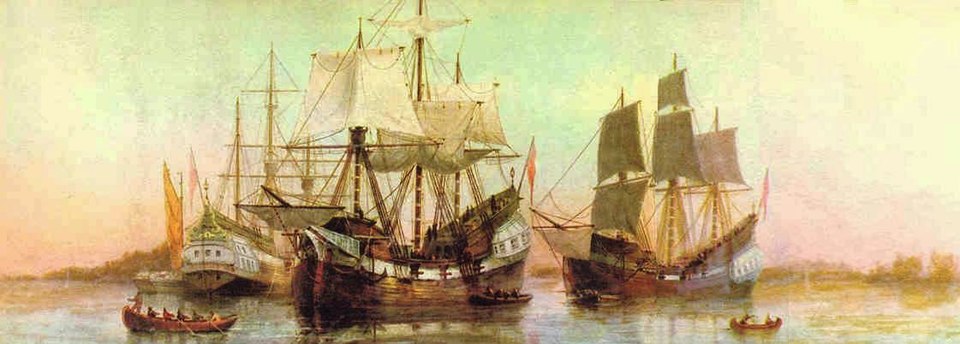
This is the immigration story of my 9th great-grandfather, Edward Spalding (1601-1669), the progenitor of the Massachusetts branch of the Spalding/Spaulding family, and the first to bring the surname from England to the New World.1
Arrival Theories
Historical and genealogical research is exhilarating, challenging, and yes at times, frustrating. New evidence is discovered each year, rendering the emergence of new theories. The arrival story of Edward Spalding to the English colonies in America is a convergence of theories resulting in causes of debate amongst family historians for over a century.
The Spalding Memorial: A Genealogical History of Edward Spalding of Virginia and Massachusetts Bay and His Descendants, published by Charles W. Spalding in 1897, purports that Edward Spalding arrived in the colonies at Jamestown in 1619 and later removed to the Massachusetts Bay colony in the 1630s. In The Spalding Memorial, Charles writes:
“After careful and diligent research, conclusive evidence proves that Edward Spalding came over from England with Sir George Yeardley, in 1619 or about that time. There is documentary evidence that Edward Spalding and his family were fully established in the Virginia Colony in the year 1623 as his name appears in these Virginia Colonial Records”.2
“We shall speak of Edward Spalding, the progenitor of the New England family of that name. Edward of Virginia and Edward of Massachusetts Bay, without doubt, are identical.”3
Dr. Stephen W. Spaulding’s research, documented in a 2019 article in The New England Historical and Genealogical Register titled, “How Edward Spalding, a Puritan Farmer from the Norfolk–Suffolk Border, Came to Prosper in New England”, asserts that Edward Spalding likely migrated directly to the Massachusetts Bay Colony directly from England with his family in the late 1630s.4
The suppositions conveyed by these family historians presents us with a mystery of two arrival theories.
The first theory is that Edward Spalding of the Jamestown settlements is the same Edward that later migrated to the Massachusetts Bay Colony. The second theory is that Edward Spalding and his family immigrated directly from England to Massachusetts. Exactly when and how Edward Spalding and his family arrived in Massachusetts is not definitively known. The reason is record evidence, such as a ship’s manifest containing Edward’s name, doesn’t exist for either of the two arrival theories.
These two arrival theories do, however, converge in Braintree, Massachusetts, in the 1630s with multiple records of Edward Spalding’s assimilation into the Massachusetts Bay Colony.
Arrival Theory One
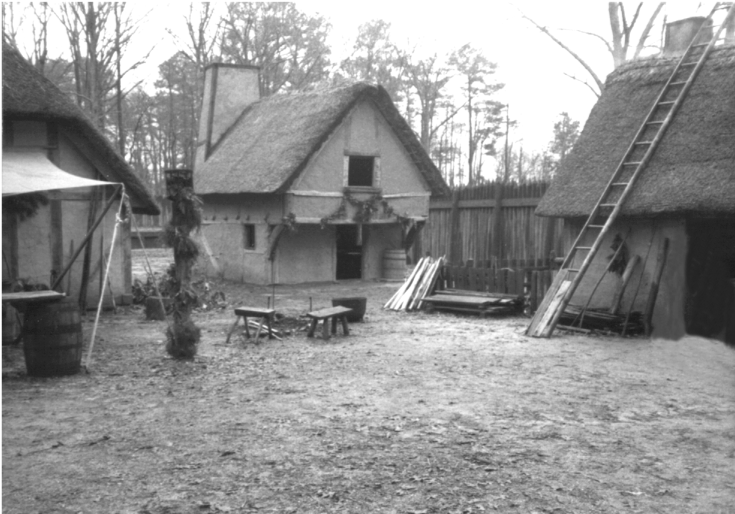
On January 19, 1619, Edward Spalding was off on his adventure to the New World when he set sail with Sir George Yeardley of London aboard the George, a 150-ton vessel. After a brief stop in Bermuda to avoid rough seas, the ship arrived at the mouth of the Chesapeake Bay, turned north up the James River, and docked in at the Jamestown Settlements on April 18, 1619.5
Private land ownership became a reality in Virginia during this period. All freemen (those who had paid their passage to America) were granted 100 acres of land. However, many could not afford the costly trip to the New World and thus obtained their passage as indentured servants. Edward Spalding was such an indentured servant.
Just as the future was looking bright for the colony, Indian Chief Powhatan, friendly to the settlers, died. Chief Powhatan’s brother Opechancanough became Chief, but he didn’t share his brother’s friendly posture toward the settlers. Early in the morning on March 22, 1622, Opechancanough led a colossal attack on the settlements. During the attack, the Indians used whatever makeshift weaponry they could lay their hands on, such as hoes, rakes, shovels, axes, or hammers—the very same tools the settlers used the day before to work their plantations.6
More than 300 settlers were killed (about one-third the population); disease subsequently ran rampant, and many settlers fled the area, reducing the number of settlements in the region from eighty to eight.7
Following the carnage of 1622, George Sandys, treasurer of the Virginia colonies, sent a letter to London via the Seaflower, informing the authorities of the massacre. He later sent “a perfect catalogue” of the names of the people who had perished and of those who were still alive. This record known as The Lists of the Living and the Dead in Virginia was produced on February 16, 1623. Edward Spalding and his family are listed with others “Att James Cittie and within the Corporation thereof” as follows:8
“Edward Spalding,
uxor Spalding,
puer Spalding,
puella Spalding“
“Uxor” Spalding from the Latin translates to “wife of” and “puer” Spalding and “puella” Spalding translates to “son of” and “daughter of.”
Edward Spalding’s indenture contract, providing his passage from England to the colonies, stipulated a provision for lodging. A document dated February 16, 1624, recorded in the Virginia Immigrants and Adventures (1607-1635), states that Edward, his wife, a son, and a daughter were “living in urban Jamestown in Mr. Cann’s household.”9
During these difficult times, some settlers returned to England; however, Edward was not ready to give up his dream just yet. By the late-1620s, Edward likely learned of the successful colonies in New England, hoping perhaps to someday find peace and prosperity there. He was not alone, as an 1848 study of early English colonists in Virginia by Horatio G. Somerby concluded that “great numbers came to New England from Virginia.”10
Arrival Theory Two
The second theory of Edward Spalding’s arrival, asserted by family historian Dr. Stephen W. Spaulding, is that he and his family likely migrated directly from England to the Massachusetts Bay Colony. Dr. Spaulding maintains Edward settled in Braintree, Massachusetts arriving in 1639 during The Great Puritan Migration and is among the thousands whose English origins have not been definitively established.11
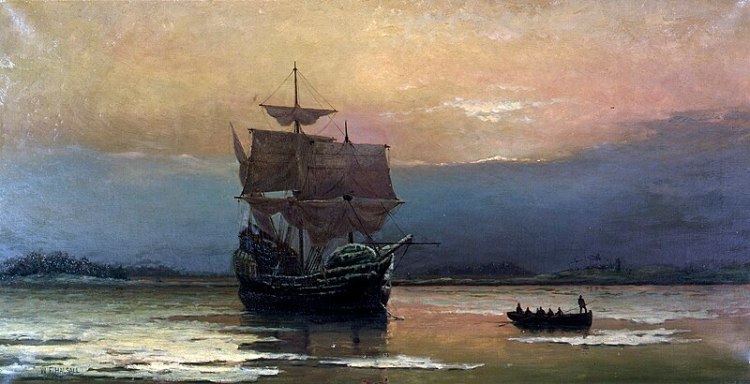
Dr. Spaulding argues that in The Spalding Memorial (1897), Charles W. Spalding incorrectly claims that Edward Spalding was in Virginia prior to migrating to Massachusetts.24 In other words, Edward of Virginia (arrival 1619) is a different Spalding than Edward of Massachusetts (arrival 1639).
Dr. Spaulding also adds that two wills providing genealogical information on Edward’s wife, Margaret, and his mother, Diana (Mowling) Spalding, indicate the family had strong Puritan connections. These wills also link the family to Puritans with robust associations in the New England colonies.11
The convergence of the two arrival theories occurs in the late 1630s, when Edward Spalding and his family reached New England and settled in Braintree, Massachusetts. Also in the Braintree community lived Henry and Edith Adams, the ancestors of the second U.S. President, John Adams, and sixth U.S. President, John Quincy Adams.
By the early 1640s, everything was going quite well for the Spalding family. On May 13, 1640, Edward was made a freeman and became a member of the established church of the province. He could now take part in local government affairs. Fifteen years later in 1655, Edward Spalding and four of his friends founded the town of Chelmsford, Massachusetts.
A Time to Build
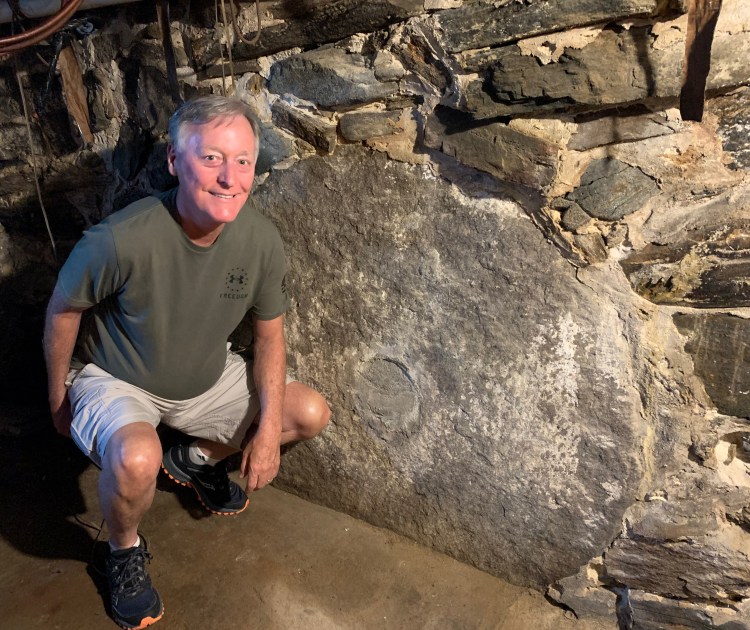
(Pictured with Dale Spaulding, 2021)
In 1664, Edward Spalding built a home on his six acres of land in Chelmsford. Known as the Spalding House, it’s still standing today in this quaint New England municipality. On this property, Edward Spalding established the first apple orchard in Chelmsford. At the time, Edward’s orchard had quite a fine reputation as the Spalding Apple was highly regarded as one of the best in the area for many years.12
Today, the Spalding House still stands and contains some of the original wood beams and brickwork from 1664. Unique wooden “tree nails” or pegs that held the mortise and tenon joints together are still visible in the home. An old millstone was reused in the basement construction as part of the 1664 foundation.
I had the unique opportunity to visit the Spalding house in 2021. Walking on the same wooden floors and in the basement built by the hands of my 9th great-grandfather over 350 years ago was a impactful moment in my life as a family historian.
Edward Spalding’s adventurous life well-lived came to an end on February 26, 1669 at age 68. He is buried in the Forefathers Burying Ground in Chelmsford, Massachusetts.
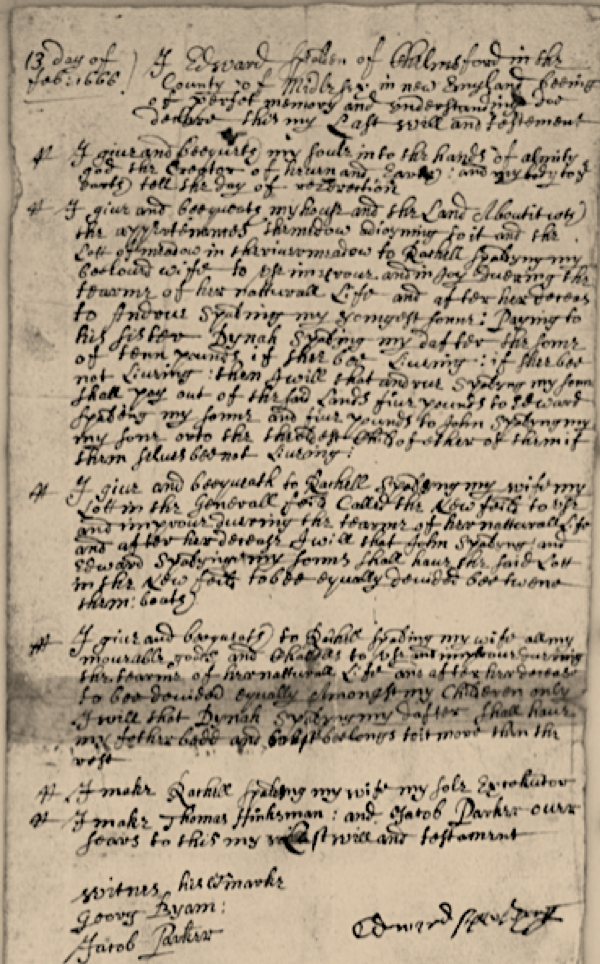
A Final Thought
Indeed, validating family history from over 400 years ago is a challenging task. If I could turn back time to 1623, I would urge colonial leaders of the Jamestown settlements to publish the actual names of women and children in The Lists of the Living and the Dead in Virginia as opposed to using the Latin uxor (wife of), puer (son of), and puella (daughter of). A record of actual names would permanently solve the mystery of Edward Spalding’s immigration arrival that has puzzled Spalding/Spaulding family historians for over 150 years.
If you enjoyed reading this post, please scroll down and click the LIKE button and share your thoughts in the COMMENT section below!
NOTES
- Spaulding, Dale. Fortitude: Preserving 400 Years of an American Family’s Faith, Patriotism, Grit, and Determination. (Ohio: Gatekeeper Press, 2022), p. 23.
- Spalding, Charles. The Spalding Memorial: A Genealogical History of Edward Spalding of Virginia and Massachusetts Bay and His Descendants. (Illinois: American Publishers Association, 1897), pp. 61-62.
- Spalding, Charles. The Spalding Memorial, p. 63.
- Spaulding, Stephen. “How Edward Spalding, a Puritan Farmer from the Norfolk–Suffolk Border, Came to Prosper in New England,” The New England Historical & Genealogical Register (Massachusetts: NEHGS, Vol. 173, 2019), p. 225.
- Encyclopedia Virginia. Sir George Yeardley (bap. 1588 – 1627). Accessed from https://encyclopediavirginia.org/entries/yeardley-sir-george-bap-1588-1627/ on March 19, 2025.
- Deetz, James. Flowerdew Hundred: The Archaeology of a Virginia Plantation (1619-1864). (Virginia: University of Virginia Press, 1993), p. 46.
- Billings, Warren. Jamestown and the Founding of the Nation. (Pennsylvania: Thomas Publications, 1991), p. 53.
- Coldham, Peter. The Complete Book of Emigrants (1607-1660). (Maryland: Genealogical Publishing Company, 1987), p. 38.
- McCartney, Martha. Documentary History of Jamestown Island, Volume III: Biographies of Owners and Residents.(Virginia: Colonial Williamsburg Foundation, 2000), p. 336.
- Spalding, Charles. The Spalding Memorial, p. 65.
- Spaulding, Stephen. “How Edward Spalding, a Puritan Farmer from the Norfolk–Suffolk Border, Came to Prosper in New England,” p. 220.
- Spaulding, Dale. Fortitude, p. 48.
- Featured Image: Arrival of Winthrop’s Company in Boston Harbor (1630) by William Formby Halsall (painted ca. 1880). Accessed from https://commons.wikimedia.org/wiki/File:Puritan_Great_Migration_Editing_Guidance-1(1).jpg on March 20, 2025. Public Domain.
- Mayflower Arrival in Plymouth Harbor by William Halsall (painted 1882). Accessed from https://commons.wikimedia.org/wiki/File:Mayflower_in_Plymouth_Harbor,_by_William_Halsall.jpg. on March 20, 2025. Public Domain.
Discover more from Fortitude
Subscribe to get the latest posts sent to your email.
 Fortitude
.jpg)

My ancestor William Capps and his wife traveled from England and was on the Sea Venture. He represented Kecoughtan, one of the eleven settlements gathered in the assembly of Virginia. One of his concerns there was to have the name of the village changed from Kecoughtan to the less native and more English name of Elizabeth City, a goal he accomplished
LikeLiked by 1 person
Thanks Teresa for sharing your family’s first immigrant story. It’s so interesting to discover the details of the lives of our ancestors from hundreds of years ago.
LikeLike
Extremely interesting and well written! Thank you for sharing. I have been curious about my family history for some time. Furthest back i can find is below:
Robert Grant Spaulding Sr 1935-2018
William Spaulding 1866- Unknown – Benson and Frankfort Kentucky
Jerry Spaulding 1842-Unknown – Frankfort Kentucky
Would be very interested to know if you have any records further than what I could find for Jerry Spaulding, and perhaps where the “U” was added along the way.
Would I be a descendent of Edward Spalding? Or is it likely there were others who emigrated?
Thanks for your time.
Jacob
LikeLike
Extremely interesting and well written! Thank you for sharing. I have been curious about my family history for some time. Furthest back i can find is below:
Robert Grant Spaulding Sr 1935-2018
William Spaulding 1866- Unknown – Benson and Frankfort Kentucky
Jerry Spaulding 1842-Unknown – Frankfort Kentucky
Would be very interested to know if you have any records further than what I could find for Jerry Spaulding, and perhaps where the “U” was added along the way.
Would I be a descendent of Edward Spalding? Or is it likely there were others who emigrated?
Thanks for your time.
Jacob
LikeLiked by 1 person
Hi Jacob – thanks for reaching out. I’ll connect with you via email to answer your questions. In the meantime, for others viewing the thread on this post, I have two resources to recommend:
1. The Spalding Memorial, published in 1897, by Charles Warren Spalding.
2. Fortitude: Preserving 400 Years of an American Family’s Faith, Patriotism, Grit and Determination, published in 2023, by Dale R. Spaulding (me).
Fortitude is available via ebook, paperback or hardcover on Amazon here:https://www.amazon.com/Fortitude-Preserving-American-patriotism-determination/dp/1662915322/
LikeLike
Hi Dale, Edward is also my 9th ggrandfather, through his son John. I would love to know if you’ve found anything concrete regarding arrival in the colonies. I also have both arrival stories and “sources” that seem to support each.
thanks, Amanda
LikeLiked by 1 person
Hi Amanda,
Great question! Don’t think any Spaulding/Spalding family historians have found that one piece of concrete evidence yet. There are so many ship manifests from the Great Puritan Migration (1620-1640) that would cover Edward’s arrival period directly from England to Massachusetts – BUT, I haven’t seen his name on any of those manifests!
There is some circumstantial evidence of his later arrival (after 1630) vs. the 1619 arrival in Jamestown. Circumstantial evidence such as his marriage to Margaret on 16 Sep 1623 in Redenhall, Norfolk. And the birth of his children Grace, Edward, and John – all in Dickleburgh, Norfolk, England between 1624 and 1635 (see: https://www.wikitree.com/wiki/Spaulding-212).
But Charles Warren Spalding (author of the 1897 version of The Spalding Memorial) was convinced that Edward first came to Jamestown and then migrated to Massachusetts when he said, “Edward of Virginia and Edward of Massachusetts Bay, without doubt, are identical.”
And Dr. Stephen W. Spaulding makes a great case for Edward’s later arrival directly from England to Massachusetts in: “How Edward Spalding, a Puritan Farmer from the Norfolk–Suffolk Border, Came to Prosper in New England,” The New England Historical & Genealogical Register (Massachusetts: NEHGS, Vol. 173, 2019), p. 225. A well thought out theory, but, again, no piece of actual record evidence (ex. ship manifest).
So the search continues for that one piece of concrete evidence.
Perhaps someday it will be found.
Thanks for reaching out!
Dale
LikeLike