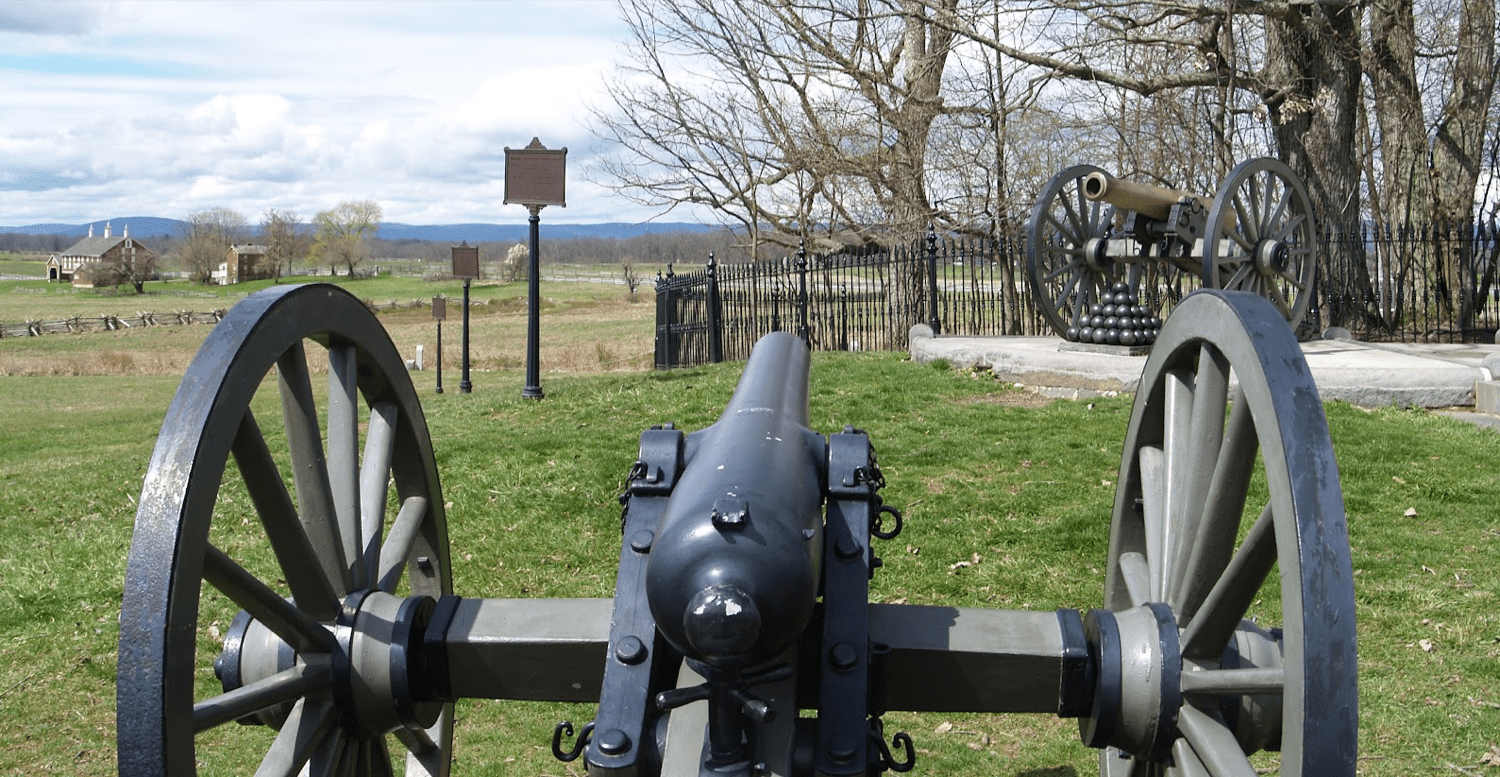
July 1-3, 1863 marked the turning point in the American Civil War. In a small town in central Pennsylvania, a massive force of Union and Confederate troops clashed at a place called Gettysburg. Gettysburg was the “High Water Mark” of the Confederate Army’s penetration into the north. The fate of the republic was at stake – if General Robert E. Lee broke through the Union lines at Gettysburg, there was no other force to stop a potential Confederate march on Washington D.C.
The Battle of Gettysburg was the single bloodiest battle of the Civil War. After the roar of the cannons and muskets ceased, the horrific carnage was revealed – over 51,000 causalities (killed, wounded, captured, missing).1
Although several of my Spaulding ancestors served in the Civil War (chronicled in previous posts), none of my direct line fought at the Battle of Gettysburg. However, five of my distant Spaulding cousins did serve in this battle that ultimately preserved the Union. In this month’s Fortitude post, I share their stories.
A Family’s Fight
The Spalding/Spaulding family sacrificed greatly (and willingly) during the American Civil War to end slavery and preserve the Union. A search of the National Park Service (NPS) Civil War Soldiers and Sailors System revealed that 1,793 Spalding/Spauldings served in the Union Army.2
Now to recount the heroics of five Spalding/Spauldings who served at the Battle of Gettysburg. Each of these men has a story – a story of honor, a story of courage, a story of perseverance and love of country.
Brevet Brigadier General Ira Spaulding (1818-1875)

Leading up to the Gettysburg Campaign, Major Ira Spaulding led the 50th New York Engineer Regiment. Troops under his command were responsible for building and maintaining bridges and railroads for the movement of men and supplies to regional battlefields.
During the Gettysburg campaign, the 50th New York Engineer Brigade numbered 946 men. The brigade supported the Battle of Gettysburg by building and maintaining pontoon bridges to facilitate northern movement of Union army across the Potomac River.
On April 9, 1865 (two years following Gettysburg), Ira Spaulding was promoted to Brevet Brigadier General of U.S. Volunteers for gallantry and meritorious service in operations resulting in the fall of Richmond and the surrender of General Robert E. Lee’s Army of North Virginia.3
You may be wondering about the word “brevet”. A brevet rank was a promotion (in title only) as a reward for outstanding service without the corresponding pay. Following the Civil War, U.S. Army brevet ranks were gradually removed with officers rewarded instead with military decorations.4
Lieutenant Colonel Joseph W. Spaulding (1841-1919)
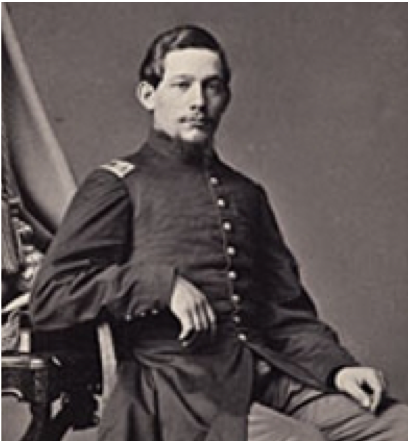
Joseph Spaulding joined the Union Army in 1862 and was assigned to Company A of the 19th Maine Infantry Regiment. On July 2, 1863, during the Battle of Gettysburg, the 19th Maine Infantry was integral in preventing a collapse of the Union line on Cemetery Ridge. The following day, the 19th Maine was located only yards from the “High Water Mark” of the Confederacy and endured heavy fighting during Pickett’s Charge.
In 1864, Joseph Spaulding was promoted to Lieutenant Colonel and put in command of the 19th Maine Infantry Regiment. In addition to Gettysburg, he fought in 20 engagements during the Civil War to include battles at the Wilderness, Spotsylvania, Cold Harbor, Petersburg, and Sailor’s Creek.
Lieutenant Colonel Spaulding’s 19th Maine Infantry Regiment was present at General Lee’s surrender of the Confederate Army at Appomattox Court House on April 9, 1865. These are a sampling the words spoken by Spaulding describing that day:
“Sunday, April 9th will ever mark a great epoch in the history of our country. It was a bright, beautiful Sabbath day; the men were in the very best of spirits. We believed we were facing either a great and important general battle, or that the end had come. General Meade riding at a very rapid speed rode along the whole length of our brigade line giving the news to each regiment with his own mouth crying out like a boy: Peace, boys, peace! Lee has surrendered!”5
“Then such a scene followed. Such rejoicing! Such cheering! The sun itself was almost obscured with hats, coats, blankets, haversacks, tossed high in the air. Tongue nor pen cannot begin to describe nor imagination depict that scene. No commissary was there, but men were drunk, drunk, from the effervescence of their own exuberance. It was the most contagious sort of inebriation – without respect to rank or condition – all were its victims – all were overwhelmed.”5
Major Israel P. Spalding (1825-1863)

Israel Spalding joined the Union Army on August 21, 1862 and was assigned to Company I of the 141st Pennsylvania Infantry.
At the Battle of Gettysburg on July 2, 1863, the 141st Pennsylvania was detached from the First Brigade and deployed to the southern part of the Peach Orchard. During the fight, the 141st suffered a devastating volley at close range from one of General Barksdale’s Mississippi regiments resulting in nearly 70% of the unit killed, wounded, or missing in action.6
On the eve of the Battle of Gettysburg, in his last letter to his wife Ruth, Israel Spalding writes: “The enemy are now in my native State and I shall not fail in my duty to the flag we follow nor disgrace the uniform I wear.”7
While at Gettysburg, Major Spalding’s conduct was heroic as he was twice wounded while fearlessly exposing himself to lead his men. One mini-ball struck his thigh and another shattered his ankle joint. All night he lay upon the battlefield, amid the dead, dying, and wounded. The next day Confederate Colonel Humphreys, of the 18th Mississippi Regiment, who held the ground, ordered Major Spalding carried to the rear where a surgeon dressed his wounds. His ankle was so badly shattered that his leg was amputated below the knee.7
Over the next three weeks, Major Spalding continued the fight for his life but ultimately succumb to his wounds on July 28, 1863.
Sergeant Stillman C. Spaulding (1832-1887)
Stillman Spaulding joined the Union Army on April 13, 1862 and was assigned to Company K of the 32nd Massachusetts Infantry.

Later that year on December 14, 1862, following the Battle of Fredericksburg, Sergeant Spaulding wrote: “It was impossible for the men in our brigade to obtain water without crossing the plain below us, which was a hazardous thing to attempt to do, as he who ventured was sure to draw the enemy’s fire; nevertheless, it was not an uncommon thing to see a comrade take a lot of canteens and run the gauntlet.”8
On June 29, 1863, the 32nd Massachusetts, under the command of Lieutenant Colonel George Prescott, was ordered to Gettysburg, where they arrived on July 2nd after a three-day march.
On July 2, 1863, the 32nd Massachusetts fought on the south slope of the Stony Hill and again in the Wheatfield. The boys from Massachusetts suffered their heaviest casualties of the war in the fighting that day. In both actions, 81 of the 227 officers and men (35%) of the 32nd Massachusetts were killed or wounded. At 8 o’clock that evening, the battle-worn men of the 32nd received orders by General Sykes to withdraw behind Little Round Top.9
Following the Civil War, Stillman C. Spaulding, designed the 32nd Massachusetts Monument dedicated at Gettysburg in 1894. The monument is unique in its shape of a “dog tent”. These two-man, cramped sleeping shelters were nicknamed “dog tents” by soldiers declaring they were barely fit for a dog.

Private Lilburn A. Spaulding (1843-1916)
Lilburn Spaulding was assigned to Company K of the 24th Michigan Infantry Regiment in the Union Army’s “Iron Brigade”. The Iron Brigade was noted for their excellent discipline, ferocity in battle, and extraordinarily morale.10
On the first day of the Battle of Gettysburg, thirteen different men carried the colors of the 24th Michigan. Eleven of them were killed or wounded. So many color bearers fell that the regiment’s commander, Colonel Henry Morrow, took up the flag to rally his men.
Private William Kelly of Company K then bravely stood to take the colors from the colonel’s hands proclaiming, “The Colonel of 24th shall never carry the flag while I’m alive.” Private Kelly was killed instantly, falling at Colonel Morrow’s feet. The 24th Michigan’s colors were then carried by Private Lilburn Spaulding. Finally, Colonel Morrow once again waved the colors to rally his decimated ranks until he was wounded in the head near Seminary Ridge.11

Miraculously, Private Spaulding wasn’t wounded during the intense fighting at Gettysburg. Perhaps it was a matter of divine protection as he had just recovered from his wounds received three months earlier at the Battle of Fitzhugh Crossing in Virginia.12
Gettysburg Address
In November 1863, four months after that infamous battle, President Abraham Lincoln, delivered one of the most eloquent speeches in American history – The Gettysburg Address. Many of us recall the President’s opening of “Four score and seven years ago…”. However, as I write this post, I am drawn to these words:
“The world will little note, nor long remember what we say here, but it can never forget what they did here.”13
With a grateful heart, I salute the Spalding/Spauldings who served with distinction at Gettysburg and I remember the sacrifice of Major Israel P. Spalding who was mortally wounded during that monumental battle.
The Toughest Test in American History
Becoming a Gettysburg Licensed Battlefield Guide is notoriously difficult. The process involves rigorous study, multiple stages of assessment, and ultimately, a grueling final exam. According to a 2025 CBS News report, the exam a potential guide needs to pass is dubbed the “toughest test in American history,” with a nearly 90% failure rate.14
NOTES
- American Battlefield Trust. Gettysburg. Accessed from https://www.battlefields.org/learn/civil-war/battles/gettysburgon May 2, 2025.
- National Park Service: The Civil War: Search for Soldiers. Accessed from https://www.nps.gov/civilwar/search-soldiers.htm on May 2, 2025.
- Arlington National Cemetery. Ira Spaulding – Brigadier General, United States Army. Accessed from https://www.arlingtoncemetery.net/ispaulding.htm on April 19, 2025.
- Britannica. Brevet: Military Rank. Accessed from https://www.britannica.com/topic/brevet on April 19, 2025.
- Smith, John. The History of the Nineteenth Regiment of Maine Volunteer Infantry 1862-1865. (Minnesota: The Great Western Printing Company, 1909), pp. 306-307.
- Wikipedia. 141st Pennsylvania Infantry Regiment. Accessed from https://en.wikipedia.org/wiki/141st_Pennsylvania_Infantry_Regiment on April 25, 2025.
- Craft, David. History of the One Hundred Forty-First Regiment Pennsylvania Volunteers 1862-1865. (Pennsylvania: Reporter-Journal Publishing Company, 1885), pp. 129-130.
- Parker, Francis. The Story of the Thirty-Second Regiment Massachusetts Infantry. (Massachusetts: C.W. Calkins & Co., 1880), p. 133.
- Killed at Gettysburg. The Final Footsteps of Gettysburg’s Fallen. Accessed from https://killedatgettysburg.org/charles-appleton-company-g-32nd-massachusetts-infantry/ on April 27, 2025.
- Wikipedia. Iron Brigade. Accessed from https://en.wikipedia.org/wiki/Iron_Brigade on April 30, 2025.
- Curtis, A.M. History of the Twenty-Fourth Michigan of the Iron Brigade. (Michigan: Winn & Hammond, 1891), p. 165.
- Ibid., p. 131.
- National Constitution Center. The Gettysburg Address (1863). Accessed from https://constitutioncenter.org/the-constitution/historic-document-library/detail/abraham-lincoln-the-gettysburg-address-1863 on May 2, 2025.
- CBS News. 2025. Meet the history buffs spending years studying to become Gettysburg Battlefield guides. Accessed from https://www.cbsnews.com/video/commemorating-the-battle-of-gettysburg-turning-point-of-the-civil-war-162-years-later/ on June 30, 2025.
IMAGES
15. Featured Image: Spaulding, Randy. 2024. Artillery Pieces on Gettysburg Battlefield.
16. FindaGrave.com. Bvt. Brig. Gen. Ira Spaulding. Accessed from https://www.findagrave.com/memorial/12948/ira-spaulding on May 13, 2025.
17. FindaGrave.com. Lt. Col. Joseph W. Spaulding. Accessed from https://www.findagrave.com/memorial/51863202/joseph-whitman-spaulding on May 13, 2025.
18. Civil War Photo Sleuth. Maj. Israel P. Spalding. Accessed from https://www.civilwarphotosleuth.com/photos/view/9417/ on May 13, 2025
19. Heritage Auctions. Civil War Belongings of Stillman C. Spaulding. Accessed from https://historical.ha.com/itm/military-and-patriotic/civil-war/grouping-associated-with-massachusetts-volunteer-the-following-five-items-belonged-to-stillman-c-spaulding-of-newton-mass-total-5/a/6015-57930.s# on April 27, 2025.
20. The Historical Marker Database. 32nd Massachusetts Monument. Photographed by Karl Stelly, January 18, 2010. Accessed from https://www.hmdb.org/PhotoFullSize.asp?PhotoID=93270 on May 13, 2025.
21. Wikimedia Commons. 24th Michigan Infantry at Gettysburg. Accessed from https://commons.wikimedia.org/wiki/File:24th_Michigan_Infantry_on_the_first_day_of_the_Battle_of_Gettysburg.jpgon April 30, 2025.
Discover more from Fortitude
Subscribe to get the latest posts sent to your email.
 Fortitude

Amazing! You have captured my heart. Now I relly want to find out about Joseph, who wa skillled at the concord fight. No one seem to know! He was the son of Job. >
LikeLike